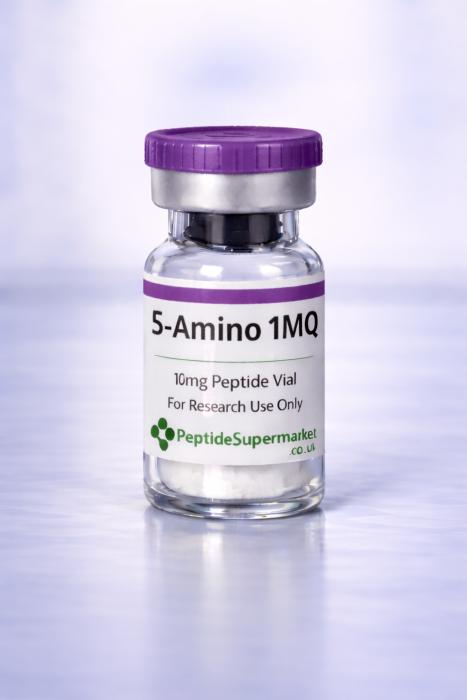
5-Amino-1MQ — where it fits, how it works, and why most dosing advice online doesn’t make pharmacological sense
Quick take
5-Amino-1MQ is positioned as a small molecule NNMT inhibitor that helps preserve nicotinamide for NAD+ production, especially inside fat (adipose) tissue, where NAD+ production relies heavily on the salvage pathway and NNMT can become a major drain.
It’s framed as most useful for people with metabolic dysfunction tied to excess body fat, because that’s where NNMT overexpression becomes the problem you’re actually correcting.
The energy system you need to understand first
Your mitochondria make ATP by running electrons through the electron transport chain.
NAD+ is described as the shuttle that makes this possible:
it picks up electrons from food-derived metabolism
carries them into the electron transport chain
electrons moving through the chain pump protons across the membrane
that gradient drives ATP production
NAD+ becomes NADH after dropping off electrons
NADH is converted back into NAD+ so the cycle can repeat
If NAD+ availability drops, electron shuttling becomes inefficient → ATP output falls → energy drops.
The NAD+ salvage pathway
Most NAD+ production is described as coming through the salvage pathway:
you take in nicotinamide (vitamin B3 form)
the body recycles it back into NAD+
This pathway is described as responsible for ~80% of NAD+ production, so protecting it matters.
What NNMT is, and why it becomes a problem
NNMT is described as a normal clearance enzyme:
it takes nicotinamide and methylates it into a waste product
that waste gets excreted
Under normal conditions, that doesn’t matter much because tissues like the liver have multiple ways to generate NAD+.
The problem is framed as being most important in adipose tissue:
fat cells rely heavily on the salvage pathway for NAD+
NNMT is described as the only major catabolic enzyme for nicotinamide in fat
when NNMT is overexpressed in adipose tissue (especially with obesity), it creates a drain on nicotinamide that fat cells need for NAD+
So you end up with two competing fates for the same input:
nicotinamide → NAD+ (energy support)
nicotinamide → waste (via NNMT)
Pricing for 5-Amino-1MQ can vary, so we’ve put together a UK price comparison hub here:
The vicious cycle in fat tissue
The mechanism is laid out as a self-reinforcing loop:
Obesity increases NNMT expression in fat
Higher NNMT activity drains nicotinamide away from NAD+ salvage
Fat-cell NAD+ drops
Fat burning becomes less efficient and fat storage becomes easier
More fat tissue → even more NNMT expression
That’s the cycle 5-Amino-1MQ is positioned to interrupt.
What 5-Amino-1MQ does
5-Amino-1MQ is framed as the compound that plugs the leak:
it blocks NNMT
by inhibiting NNMT in adipose tissue, it reduces nicotinamide waste
that shifts the balance back toward NAD+ production
So instead of losing nicotinamide to clearance, more of it becomes available to the salvage pathway.
What the animal results were described to show
In the animal model described:
mice treated with 5-Amino-1MQ lost significant body fat without changing food intake
~35% reduction in body mass
~30% decrease in fat cell size
fat loss was attributed to increased energy expenditure, not appetite suppression
The important qualifier: the model referenced was diet-induced obese mice, meaning NNMT was already elevated and the intervention was correcting a dysfunction that was present.
Who this is actually for
The target population is framed by the mechanism:
NNMT overexpression is described as correlating more with body fat than with aging
obese / metabolically dysfunctional individuals are more likely to have the “NNMT drain” that needs correcting
lean, metabolically healthy individuals likely have adipose NNMT closer to baseline → less dysfunction to fix
So the compound is framed as being more of a metabolic dysfunction tool than a “lean optimization” tool.
The dosing problem
The dosing landscape is described as chaotic and inconsistent, and the spread is massive:
translated mouse dosing (via allometric scaling) is described as roughly ~400 mg/day human equivalent
other suggestions: 50–150 mg/day oral
other suggestions: 50–100 mg/day subcutaneous
microdose suggestions: 150–600 micrograms/day
That’s described as roughly a 2,500× difference between microdose levels and what the animal-to-human translation implies.
There’s also a key limitation stated: no human trial data.
IC50 coverage — the logic used to evaluate dosing
The dosing argument is framed using IC50 coverage:
to get meaningful effect, you need enough concentration to inhibit at least ~50% of the target enzyme
below that threshold, inhibition is too small to matter
To estimate what might achieve that, the comparison used is a structurally similar small molecule:
metformin is used as the closest analog (small, positively charged, similar bioavailability and half-life)
From that comparison, the framing is:
50–150 mg/day oral plausibly reaches partial inhibition
400–600 mg/day aligns with near-complete inhibition and matches the translated mouse dose range
Microdosing is framed as being nowhere close:
a 150 microgram/day dose is described as ~400× below what would be needed for ~50% inhibition
the conclusion presented is: you can’t “outsmart pharmacology”—either the concentration is effective or it isn’t
The “NAD+ support” microdose argument — and why it’s rejected
The microdose claim is sometimes framed as “NAD+ support” rather than fat loss, but the counter-logic presented is:
the enzyme that converts nicotinamide toward NAD+ salvage is described as having far higher affinity for nicotinamide than NNMT
nicotinamide is said to preferentially flow toward NAD+ under normal conditions
NNMT only becomes a meaningful drain when it’s massively overexpressed (again pointing back to obesity / excess adipose tissue)
the lowest concentration linked to NAD+ increases in the data referenced is described as ~1,000× higher than microdose exposure
So the practical conclusion given is:
if the goal is NAD+ support, direct precursors (like NMN) or NAD+ strategies make more sense than microdosing an inhibitor that can’t reach meaningful tissue concentration
If your goal is simply to compare 5-Amino-1MQ prices (UK), use our dedicated comparison page:
Why microdose protocols exist
The explanation given is economics:
at 150 micrograms/day, a small vial lasts a long time
at multi-milligram effective dosing, it lasts only a couple days
true effective dosing becomes financially unrealistic for many people outside funded trials
so people default to what they can afford and then rely on anecdotal reports
Practical dosing guidelines described
Key practical point: 5-Amino-1MQ is a small molecule, not a peptide, and it can be taken orally.
Oral bioavailability is described as ~38%
Oral dosing framed as plausible for partial inhibition: ~50–100 mg/day
Subcutaneous dosing framed as effective at lower amounts because it bypasses digestion: ~50–100 mg/day
And the hard line stated:
microdoses “don’t make sense” and aren’t expected to produce results.
Where it fits in a protocol
It’s framed as a “support” add-on in NAD+-focused stacks:
If you’re using NAD+ and repair support, adding 5-Amino-1MQ is positioned as a way to reduce NNMT drain and preserve nicotinamide for NAD+ salvage.
If you’re using MOTS-C + NAD+ optimization, the same logic applies.
The recurring filter stays the same:
people most likely to benefit are those with metabolic dysfunction tied to excess body fat
lean, metabolically healthy people are less likely to have the NNMT overexpression problem in adipose tissue
Final take
5-Amino-1MQ is framed as:
a real compound with a real mechanism
especially relevant when NNMT overexpression in adipose tissue is part of the metabolic dysfunction picture
But the big warning is dosing:
the effective-dose logic is framed around enzyme inhibition thresholds
and most online protocols—especially microdosing—are positioned as inconsistent with basic pharmacology
And the foundation point stays consistent:
these compounds don’t replace training, nutrition, sleep, and recovery habits—they amplify a solid base.
Compare 5-Amino 1MQ prices across the UK
Side-by-side prices from every trusted UK supplier stocking 5-Amino 1MQ.


