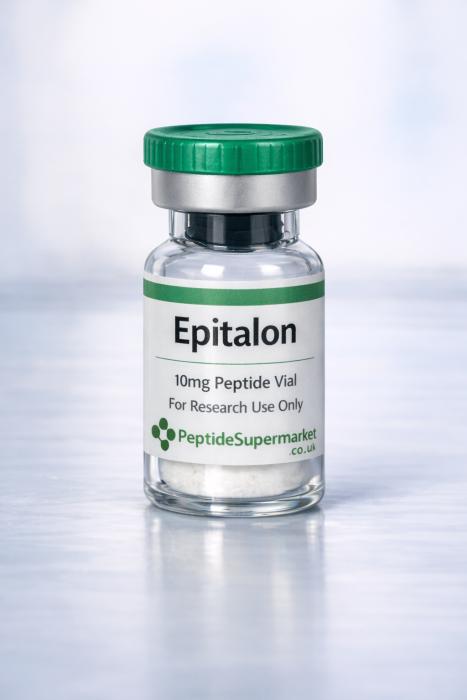
Epithalon — why sleep and recovery decline after 40, and the peptide aimed at reversing the slide
Quick take
If your sleep gets worse every year after 40 and your recovery takes longer, those aren’t separate problems. Two systems have been declining since your 20s:
Telomeres (the cellular “age clock” that limits how long cells can keep dividing)
The pineal gland (melatonin output and circadian rhythm that drives nighttime recovery)
Epithalon is presented as a peptide that helps restore function in both: telomere maintenance via telomerase reactivation, and pineal output via normalized melatonin rhythm—especially when those systems have declined with age.
Why sleep and recovery decline after 40
The pattern is described like this:
Telomeres shorten over time → more cells hit their replication limit → more inflammatory signaling → slower repair
Pineal output declines with age → melatonin rhythm flattens → sleep quality drops → growth hormone pulses shrink → recovery slows
Those two declines stack on top of each other: more inflammation + weaker nighttime recovery signaling.
How telomeres control cellular aging
Your body constantly replaces cells by division. At the ends of your chromosomes are telomeres, described as protective caps—like the plastic tips on shoelaces.
Every time a cell divides, telomeres get a little shorter because the copying machinery can’t fully replicate the very end.
When telomeres get too short, cells stop dividing safely.
At that point, cells either shut down or trigger death pathways.
Cells that shut down don’t stay quiet—they release inflammatory signals that affect surrounding tissue.
Your body does have telomerase, an enzyme that can add length back to telomeres, but in most adult cells it’s described as largely “off,” so shortening becomes a one-way trend.
Before you buy Epithalon, it’s worth checking a UK price comparison first. We keep a running list here:
Compare peptide prices UK.
How the pineal gland controls recovery
The pineal gland produces melatonin. Melatonin is framed as more than a “sleepy hormone”—it’s the signal that tells your body to shift from day mode into recovery mode:
growth hormone pulses occur at night
tissue repair ramps up
immune activity shifts into repair/surveillance
Melatonin and cortisol are described as an opposing rhythm:
Cortisol peaks in the morning and drops through the day
Melatonin rises in the evening, peaks at night, and drops toward morning
As you age, the pineal gland is described as calcifying, and melatonin output declines—by around age 60, melatonin production is described as being roughly 50% lower than in youth. The rhythm flattens, the nighttime signal weakens, and the downstream recovery stack weakens with it.
What Epithalon is
Epithalon is described as:
a synthetic peptide made of four amino acids
developed from pineal research starting in the 1980s (derived from studying pineal extracts and isolating the active sequence)
later confirmed as a sequence that naturally occurs in human pineal tissue (framed as “supplementing something that declines with age,” not introducing something foreign)
How Epithalon works
Telomere side: telomerase reactivation
Epithalon is described as small enough to enter the cell nucleus and help flip telomerase “back on” in cells where it’s been turned off—allowing telomerase to add length back to telomeres.
A specific result cited in the material:
treated cells showed a 33% increase in telomere length
control cells stopped dividing at their normal limit
treated cells continued dividing beyond that limit
Pineal side: melatonin rhythm restoration
Epithalon is described as restoring melatonin production in people where pineal output has declined:
melatonin increases during the dark period
circadian rhythm patterns shift toward a more “youth-like” profile
A key detail included:
in younger subjects with normal function, epithalon had minimal effect
the effect is described as restorative, not pushing beyond normal range
What the longer-term human outcomes were reported to show
The main outcomes described include:
12-year follow-up trial (79 patients with cardiovascular disease)
short injection cycles twice per year for 3 years, then followed for 9 more
28% lower overall mortality in the treated group
cardiovascular mortality cut roughly in half
improvements also described in endurance, melatonin rhythm, and metabolic markers
Long-term study in 266 elderly adults
epithalon group reported as having nearly twice the survival rate of controls
Study in 162 patients with a degenerative eye condition
90% reported as having positive effects
no reported side effects in that summary
Honest limitations described alongside the claims
The boundaries were stated like this:
much of the published work comes from one research group
limited independent Western replication
a significant portion of the literature is not widely accessible in English
At the same time, the logic presented is:
the mechanism is described as biologically coherent
animal data is presented as consistent across multiple studies
human data is described as promising, with unusually long follow-ups
How people are actually using Epithalon
The usage pattern described is cyclical, not continuous.
As presented:
5–10 mg subcutaneously once daily
for 10–20 consecutive days
repeated 2–3 times per year, with months between cycles
The reasoning given:
epithalon acts more like a reset—activating processes that persist after it clears
continuous dosing is described as not adding benefit over periodic cycles
Looking to compare Epithalon prices (UK)? Our price comparison hub puts the listings in one place:
What to realistically expect
Sleep improvements tend to come first (deeper sleep, feeling more rested within the first couple of weeks)
some people report vivid dreams, consistent with melatonin signaling changes
telomere-related effects are described as long-game outcomes (measured over years, not felt day-to-day)
This is framed as most relevant for adults 35+ noticing age-related decline in sleep quality and recovery.
Safety notes included with the approach
The safety profile described across decades of research is presented as generally clean, with the common reports being:
mild injection site reactions
occasional headache
temporary changes in sleep patterns
A caution highlighted:
if you have active cancer or a history of cancer, the note is to speak with your oncologist first, because telomerase activation raises questions that aren’t fully resolved in humans.
Why it won’t override bad habits
The point made is simple: epithalon supports circadian and recovery signaling, but it doesn’t cancel out behaviors that flatten melatonin rhythm—like bright screens late at night or chronic evening stress that keeps cortisol elevated.
The sequence described is:
get sleep hygiene and recovery habits in order
then use epithalon to enhance what you’ve built
Compare Epitalon prices across the UK
Side-by-side prices from every trusted UK supplier stocking Epitalon.


