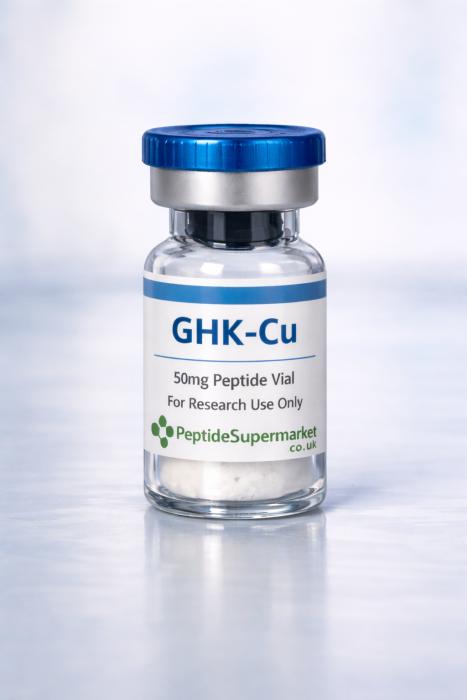
GHK-Cu.
Three amino acids. One copper ion. And the biological equivalent of finding the master answer key to what your body needs to do to regenerate like Wolverine.
And here’s what makes me insane about this: the wellness industry treats it like a cute little skin ingredient. Like it’s a trend. Like it’s face cream for soccer moms and “longevity clinics” and affiliate-code experts who learned three buzzwords and now they’re teaching biology on the internet.
Stop.
This isn’t a “biohacking trend.” Calling GHK-Cu cosmetic is like calling a nuclear reactor a space heater.
When you’re done with this, you should be asking one question:
Why isn’t this standard care for every human over 30?
It’s not synthetic. It’s you.
GHK-Cu isn’t some lab-created novelty. It’s been in your body since the day you were born.
It was discovered because somebody asked a real scientific question: why does young blood heal better than old blood?
Not vampire nonsense. Not Hollywood garbage. Straight physiology: compare young plasma vs old plasma and find the missing variable.
And one of the signals that stands out is GHK-Cu concentration.
Here’s the brutal reality:
When you’re young, you have the blueprint and the machinery and the regeneration capacity. You don’t “lose the ability to heal.”
You lose the signal.
GHK-Cu is one of those signals. It shows up in plasma, saliva, urine, and it spikes when tissue gets damaged. It’s part of your emergency response system.
And it’s not just “repair.” It’s not just “skin.” It’s not just “wrinkles.”
This is connected to gene expression.
Your genes aren’t a static fate. They’re a control panel. And GHK-Cu interacts with that control panel like it has admin access.
There’s research showing it can shift expression across thousands of genes—turning up the ones that build and repair, and turning down the ones that drive chaos.
That alone should make you sit up.
We’ve added GHK-Cu to our UK price comparison hub so you can compare the different price points easily:
Copper is not optional. It’s part of your ATP engine.
Now let’s talk about why you’re tired, why your brain feels foggy, why your recovery sucks, why your skin looks like it’s lost tension, why you don’t bounce back like you used to.
Three letters:
ATP.
Adenosine triphosphate. The energy currency of life.
Every heartbeat. Every breath. Every movement. Every repair. Every detox step. Every signal your nervous system fires—ATP.
And where does ATP come from?
Your mitochondria. The cellular power plants everyone name-drops and almost nobody understands.
Here’s the key: your electron transport chain runs through a sequence of complexes. And Complex IV—cytochrome c oxidase—is the bottleneck. It’s where oxygen gets reduced to water and where the system finishes the job cleanly.
And Complex IV is copper-dependent.
Not “benefits from copper.”
Requires copper.
The active sites in cytochrome c oxidase literally use copper centers to transfer electrons properly.
So what happens when copper availability is off?
the chain backs up
electrons leak
reactive oxygen species spike
mitochondrial damage accumulates
energy production collapses
the cell enters crisis mode
That’s not “aging.” That’s an energy failure.
Now here’s why GHK-Cu is different:
GHK-Cu doesn’t just “contain copper.” It delivers bioavailable copper in a way your cells can use—right where copper matters most.
That’s why treating it like face cream is such a joke.
It’s not lipstick.
It’s engine repair.
And it gets better: it doesn’t only help mitochondria run. It pushes the system to build more mitochondria and better-functioning ones by upregulating key biogenesis signaling.
So it’s not just “fix the power plant.”
It’s “build a whole new grid.”
The skin obsession is the dumbest interpretation of a masterpiece
People go, “My skin looks better.”
Yes. It does.
But that’s like saying oxygen is “for breathing” and ignoring that it powers literally every cell in your body.
GHK-Cu has receptors in virtually every tissue type because it is a fundamental regeneration signal.
What does it do at the cellular level?
It orchestrates the rebuild like a master contractor:
Modulates the extracellular matrix (the scaffolding that holds you together)
Increases collagen, elastin, glycosaminoglycans (not just skin—organs, vessels, connective tissue)
Balances metalloproteinases and their inhibitors so you remodel tissue correctly instead of scarring or melting
Activates adult stem cell behavior so repair isn’t sluggish and broken
That’s systemic regeneration.
Not cosmetics.
Cosmetics is what people do when they don’t understand the biology.
How it works: it enters the cell, flips switches, and talks to your DNA
Here’s the mechanism nobody explains cleanly:
Cell entry
GHK-Cu binds cell membrane receptors and gets internalized.Intracellular signaling
Once inside, it activates multiple repair-and-survival pathways—these are core switches for cell function, not trendy acronyms.Nuclear access
It gets into the nucleus. It interacts with the control center.Gene regulation
It pushes expression toward repair: collagen, antioxidant systems, angiogenesis, nerve growth, anti-inflammatory control—while turning down inflammatory and degenerative expression patterns.
That’s why it acts across systems. It’s not one pathway. It’s a reset pattern.
Which is also why the “one drug for one symptom” crowd doesn’t get it.
They’re trained to block one thing.
GHK-Cu doesn’t “block.”
It restores.
My three biological failures — and how GHK-Cu hits all of them
Every chronic disease pattern keeps collapsing into the same three failures:
Systemic inflammation
Insulin resistance
ATP shortage
Now watch how this molecule threads the needle.
1) Systemic inflammation
Chronic inflammation is what happens when inflammatory signaling stays stuck on. NF-κB, cytokines, all that mess.
GHK-Cu doesn’t suppress the immune system like steroids.
It modulates: it reduces excessive inflammatory signaling while supporting appropriate immune function.
That’s how you want it. Turn down the self-destruction without turning off defense.
2) Insulin resistance
Insulin resistance is what happens when cells stop “hearing” insulin properly. Inflammation and mitochondrial dysfunction are major drivers.
Fix mitochondria and reduce inflammatory blockade, and insulin signaling improves because the cell’s internal environment stops being hostile to glucose handling.
3) ATP shortage
We already covered the engine: copper delivery to Complex IV, improved electron transport efficiency, reduced oxidative damage, improved mitochondrial integrity, and increased biogenesis.
More ATP changes everything—repair, cognition, resilience, metabolism, recovery.
Energy abundance is not a luxury.
It’s the foundation.
The “extra” effects aren’t extra. They’re downstream of fixing the engine.
People act shocked when they hear what else this touches:
Brain
If something supports nerve growth factors, reduces neuroinflammation, supports repair, and improves energy availability, brain outcomes improve. That’s not mystical. That’s biology.
Hair
Hair follicles don’t like inflammation, poor blood flow, and stressed tissue signaling. Regenerate the local environment and follicles behave differently. Again: not magic, not vanity—environmental correction.
Wounds
Wound healing is a choreography: inflammation → proliferation → remodeling.
If a molecule can modulate inflammation, increase fibroblast activity, drive angiogenesis, and coordinate remodeling balance, it accelerates closure and improves quality.
That’s what it does.
It’s systemic pattern correction.
Quick link: UK GHK-Cu price comparison (compare listings and pricing in one place):
The adaptation principle: don’t be dumb with it
Here’s where people get reckless:
Your body adapts to everything.
Constant external signaling can lead to downregulated sensitivity over time. That’s homeostasis. That’s not “the peptide stopped working,” that’s your system recalibrating.
So the intelligent move is cycling—give the system periods to reset sensitivity while retaining the structural gains you’ve built.
The goal isn’t dependency.
The goal is restoration.
The real conclusion: aging is a signal problem
Let me bring this home.
You have a molecule inside you—one you naturally produced more of when you were young—that acts like a regeneration signal across systems, including gene expression control, mitochondrial function, inflammation modulation, tissue remodeling, and repair orchestration.
And it declines with age.
That decline correlates with:
reduced healing capacity
rising chronic disease burden
increased inflammation
reduced cellular energy
loss of resilience
That’s not “bad luck.”
That’s signal loss.
Your blueprint is still there. The machinery is still there.
What’s missing is the instruction.
GHK-Cu is the instruction.
And here’s the punchline nobody wants to say out loud:
It’s not the standard because there’s no patent jackpot, no billion-dollar marketing push, no insurance billing machine built around it. It’s a naturally occurring molecule that’s cheap to produce, so the system shrugs and throws it into the “cosmetic” trash bin.
That’s why you’re hearing about it from the internet instead of from your doctor.
So stop asking “is it good for skin?”
Ask the real question:
Why are we treating aging like an inevitability when the biology is screaming that it’s a missing signal?
Restore the signal intelligently. Respect the system. Cycle it like an adult. And watch what happens when you give a 50-year-old body the cellular instructions it used to run on at 20.
That’s not biohacking.
That’s biological intelligence.
Compare GHK-Cu prices across the UK
Side-by-side prices from every trusted UK supplier stocking GHK-Cu.


