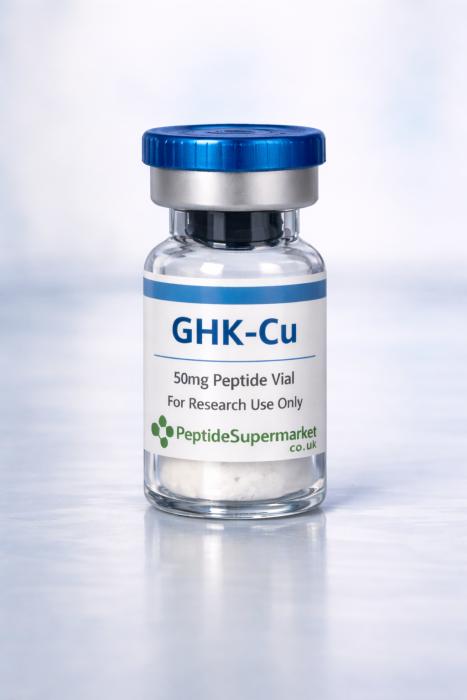
GHK-Cu: the peptide that beats influencer creams
Intro: Cheaper than influencer creams
There’s a peptide that does more for your skin than any of the creams your favorite influencer sells. It’s 10 times cheaper and it actually works.
And today I’m going to break down exactly what this stuff is, how it works in your body, what the research shows, and what kind of results you can realistically expect.
Medical disclaimer
Before we go any further, just a quick note. This is not medical advice. And I suggest that before you put anything into your body, you make sure you’re consulting with a licensed physician.
What GHK-Cu is (copper peptide complex)
So let’s start with what GHK-Cu actually is.
GHK-Cu is a copper peptide complex. It’s made of three amino acids — glycine, histidine, and lysine — bound to a copper ion, and that copper binding is what creates the active compound.
It was first discovered in human blood plasma in 1973, and they later found it naturally in saliva and urine too.
Your body’s natural tissue repair signal
Here’s the simplest way to understand GHK-Cu:
It’s basically your body’s natural signal to start repairing damaged tissue.
Whether that damage is from aging, injury, sun exposure, or just the stress you put on your body from training — when tissue gets damaged, your body releases GHK-Cu.
And what it does is tell your cells to:
make new collagen
grow new blood vessels
repair what’s been broken
Construction crew foreman analogy
Think of it like your body’s construction crew foreman.
It doesn’t do all the work itself — it coordinates the entire rebuild:
tells the right cells to show up
tells them what to build
tells them when to stop
and improves the quality of the finished tissue
Age-related decline (200 ng/mL → 80 ng/mL)
But here’s the problem.
As you age, your natural GHK-Cu levels drop significantly.
To put numbers on it:
around age 20, you’ve got roughly 200 ng/mL floating around in plasma
by age 60, that can drop as low as 80 ng/mL
So more than half of it is gone.
And that decline shows up everywhere:
skin loses elasticity and gets thinner
wounds heal slower
recovery from training takes longer
hair thins as follicles shrink
Less GHK-Cu basically means your construction crew is understaffed. Repairs happen slower and the results aren’t as good.
What supplementing does
When you supplement with GHK-Cu, you’re restoring that repair signal back toward more youthful levels.
So you’re not inventing some unnatural process — you’re turning back on a system your body already uses, but uses less of as you age.
The goal is:
faster repair
better tissue quality
improved recovery outcomes
Two forms: topical vs injectable
Now there are two forms of GHK-Cu people use.
1) Topical (the mainstream version)
This is the version you’ll see in a lot of skincare creams and serums.
It works mostly locally — at the surface and in the skin layers.
2) Injectable (systemic delivery)
This is the research chemical version.
It’s not FDA approved for human use, but it’s delivered systemically through your bloodstream, which means it can reach deeper tissues that topical products can’t.
So think of it like this:
topical = spot treatment for skin and hair where you apply it
injectable = whole-body repair signal that can reach muscles, tendons, ligaments, and deeper tissues
Looking to compare GHK-Cu prices (UK)? Our price comparison hub puts the listings in one place:
How it works: 7 cellular mechanisms
Now let me break down how this works at the cellular level, because this is why GHK-Cu is so versatile.
1) Copper delivery without toxicity
GHK-Cu delivers copper ions to your cells in a usable form.
Copper is required for enzymes involved in:
collagen production
antioxidant defense
cellular energy processes
But free copper floating around can be toxic. GHK-Cu basically acts like the safe delivery vehicle.
2) Gene expression control
This is one of the biggest points.
GHK-Cu affects thousands of genes involved in healing and tissue repair.
It turns on genes related to:
repair
regeneration
youthful cellular function
And it turns down genes tied to:
inflammation
tissue breakdown
aging-type processes
So you’re not just “adding collagen.” You’re changing what your cells are being instructed to do.
3) Collagen & elastin production (wrinkle reduction)
GHK-Cu signals fibroblasts to increase collagen production — including collagen types commonly associated with skin structure.
Skin effects:
reduced wrinkles
improved firmness and elasticity
Connective tissue effects:
stronger tendons and ligaments
improved repair quality after stress and training
4) Stem cell activation (regeneration support)
GHK-Cu helps activate dormant stem cells and attracts repair activity toward damaged areas.
This is part of why it’s described as regenerative — not just cosmetic.
5) Blood vessel formation (angiogenesis)
It promotes new blood vessel formation — angiogenesis.
That means:
better circulation into healing tissue
better nutrient delivery
faster waste removal
And this supports faster, higher quality repair.
6) Faster wound healing
It speeds up wound closure and improves the quality of healing.
Cuts, irritation, damage from training, recovery from procedures — the whole healing pipeline runs better.
7) Inflammation + antioxidant control
GHK-Cu helps balance inflammation.
It supports the healing inflammation you need short-term, while reducing the chronic inflammation that breaks you down over time.
Topical vs injectable differences
Now let’s make the practical differences really clear.
Topical GHK-Cu
works mainly in skin layers and hair follicles at the application site
typical concentrations are often around 0.5% to 2% in creams/serums
used once or twice daily
expected timeline:
skin changes: 8–16 weeks
hair changes: 16–24 weeks
generally well tolerated
limitation: mostly local effects only
Injectable GHK-Cu
systemic delivery through the bloodstream
can reach deeper tissues: muscles, tendons, ligaments, and beyond
expected timeline can be shorter depending on what you’re targeting — often 2–8 weeks for noticeable changes
but it’s higher risk because it’s not FDA approved for human use
GLOW & KLOW stacks explained
One more thing: injectable GHK-Cu is rarely used alone.
It’s commonly stacked in blends.
GLOW stack
Typically refers to a combo that includes:
GHK-Cu
TB-500
BPC-157
The idea is combining skin/hair benefits with systemic repair and recovery.
KLOW stack
This typically adds:
KPV
So it’s more focused on anti-inflammatory support layered on top of repair.
Side effects (topical & injectable)
Now let’s talk side effects, because you need to know what to watch for.
Topical side effects
Usually mild:
skin irritation
rarely allergic reactions in sensitive individuals
Injectable side effects
More noticeable:
burning sensation at injection site (common, can last 15–20 minutes)
temporary blue/green discoloration at injection site (from the copper)
metallic taste (sometimes reported)
occasional changes in appetite or energy
The big thing to watch for:
allergic reactions
and with very high dosing or sloppy use, the concern of copper accumulation and downstream issues
So you need to be careful and track what you’re doing.
If you’re researching GHK-Cu and want to compare peptide prices in the UK, start here:
Who should avoid GHK-Cu
There are groups of people who should not use this.
Avoid if you have:
Wilson’s disease
copper metabolism disorders
copper allergies/sensitivities
severe liver disease
pregnancy or breastfeeding
Avoid if you have:
active infections (copper can support bacterial activity at the site)
And the big one:
if you have any form of cancer, especially anything involving growth/repair signaling, you need to be extremely cautious and consult your physician.
My honest take
Topical and injectable GHK-Cu serve different purposes.
Topical is great for skin and hair at the application site, but it takes time — 8 to 16 weeks is a realistic window for visible skin changes, and you need consistency.
Injectable is more of a systemic repair tool — deeper tissue access, potentially faster noticeable recovery/healing effects — but it comes with higher risk because it’s not FDA approved for human use.
From what I’ve observed with people using GLOW and KLOW style stacks, most report:
faster healing from training stress
better skin quality
better recovery between sessions
reduced inflammation and joint discomfort
The most common complaint is the burning sensation — but most people find it manageable.
The most important practical rule if you’re building stacks:
only add one new compound at a time so you can identify what’s causing benefits or side effects.
And like I say in every video, this is a tool — it’s not replacing sleep, nutrition, and training.
Compare GHK-Cu prices across the UK
Side-by-side prices from every trusted UK supplier stocking GHK-Cu.


