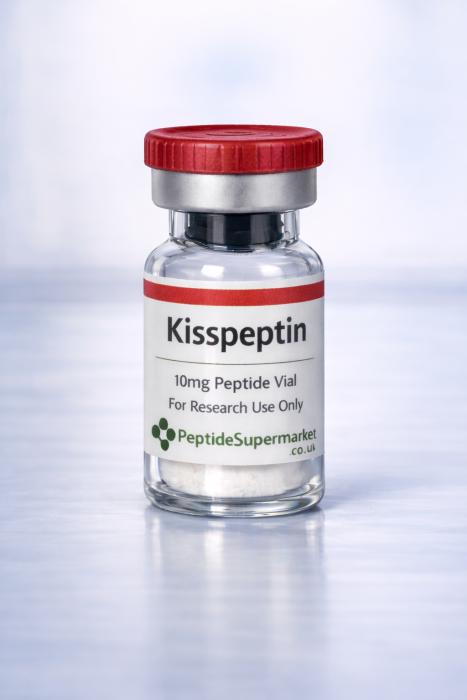
Kisspeptin’s Impact on Reproductive (and “Everything Else”) Systems
If you only know kisspeptin as a “fertility peptide,” you’re missing what it actually is:
Kisspeptin is the gatekeeper signal that turns the GnRH system on.
And GnRH isn’t “a fertility thing.” It’s the upstream command that drives the entire hypothalamic–pituitary–gonadal (HPG) axis: puberty timing, ovulation/testosterone production, and the endocrine rhythms that ripple into bone, metabolism, and brain function.
The non-negotiable biology
Researchers learned how upstream this system is the hard way: loss-of-function mutations in the kisspeptin receptor pathway (KISS1/KISS1R, historically called GPR54) cause hypogonadotropic hypogonadism—failure to initiate normal puberty and reproductive function. Translation: you don’t “run fertility” without this switch.
The Core Circuit: How the “Switch” Flips
Step 1: Kisspeptin → GnRH neuron activation
Kisspeptin binds KISS1R on GnRH neurons in the hypothalamus. That binding is the “permission slip” that allows GnRH neurons to fire in a coordinated way.
Step 2: GnRH pulses → Pituitary release of LH/FSH
GnRH is released in pulses into the hypothalamic–pituitary portal system, stimulating the anterior pituitary to release:
LH (luteinizing hormone)
FSH (follicle-stimulating hormone)
Step 3: LH/FSH → Gonads → Sex steroids + gamete maturation
In ovaries: follicle growth, estradiol production, ovulation
In testes: testosterone production and spermatogenesis support
This is why kisspeptin isn’t “part of reproduction.” It initiates and coordinates it.
Why Pulses Matter: The KNDy “Pulse Generator”
The part social media almost always misses: your HPG axis is a rhythm machine.
A major driver of that rhythm is a network in the arcuate nucleus involving neurons that co-express:
Kisspeptin
Neurokinin B
Dynorphin
These are the KNDy neurons, widely discussed as a core component of the GnRH pulse generator. This is how the system avoids constant stimulation (which tends to desensitize receptors) and instead uses timed pulses that preserve responsiveness.
And it’s not just “reproductive timing.” This pulse generator is where stress, energy status, and internal state get translated into endocrine decisions.
If your goal is simply to compare Kisspeptin prices (UK), use our dedicated comparison page:
“Not Just Fertility”: Kisspeptin Receptors Are Widespread
One of the strongest reasons kisspeptin keeps showing up in “non-reproductive” conversations: KISS1/KISS1R signaling exists beyond the hypothalamus, including in brain regions involved in emotion, reward, and sexual processing.
Brain, mood, motivation, sexual desire: human evidence
Human studies using neuroimaging show kisspeptin can modulate limbic brain activity (the circuitry involved in attraction, arousal, emotional salience), and clinical work in hypoactive sexual desire disorder reports improvements in sexual brain processing and distress metrics with kisspeptin administration.
Important nuance: these are measurable brain/behavior effects in controlled settings—not proof that kisspeptin “cures” anxiety/depression or replaces psychotherapy/psychiatry wholesale.
Clinical Reality Check: Where Kisspeptin Is Actually Used
Kisspeptin isn’t just theory—there’s real clinical investigation in reproductive medicine.
A well-known example: kisspeptin has been studied as a way to trigger oocyte maturation in IVF contexts, leveraging its ability to stimulate endogenous gonadotropin release.
That matters because it anchors the conversation to what’s real: this pathway can be manipulated clinically, but it’s done under medical protocols—not “stacked” casually because someone yelled confidently into a microphone.
Want to compare Kisspeptin prices in the UK? See our Kisspeptin price comparison page here:
Pregnancy and the Placenta: Kisspeptin as a Placental Signal
Kisspeptin is also strongly linked to placental biology:
It’s produced at high levels by the placenta during pregnancy (and studied as a marker of placental function).
Recent work has explored circulating kisspeptin as part of risk assessment in pregnancy outcomes (e.g., miscarriage), though this remains an active research area rather than a DIY treatment story.
Bottom line: pregnancy is the last place for “experimenting” with upstream endocrine signals outside specialist care.
What People Get Wrong Online
1) “It’s just testosterone/estrogen.”
No. Kisspeptin is upstream control. Sex steroids are downstream outputs in a feedback loop.
2) “If it’s a signal, constant signal = better.”
Biology is full of systems where pulsatility is the feature, not a bug. The KNDy/GnRH pulse architecture is central to normal function.
3) “It controls everything so it fixes everything.”
Kisspeptin is a powerful coordinator, but outcomes depend on context: energy availability, stress physiology, baseline endocrine status, sex, age, and the specific clinical problem being targeted. The human data is exciting in specific domains (reproductive stimulation; sexual processing), but it’s not a magic master key for every disease.
Practical Takeaways (without the hype)
If you’re thinking about kisspeptin, think systems + rhythm: stress load, sleep, energy availability, and endocrine feedback loops heavily influence this axis.
The strongest human/clinical grounding today sits in reproductive endocrinology and sexual brain processing research, not “longevity stacks.”
If someone is selling it as a universal cure-all, they’re skipping the most important word in physiology: context.
Compare Kisspeptin prices across the UK
Side-by-side prices from every trusted UK supplier stocking Kisspeptin.


