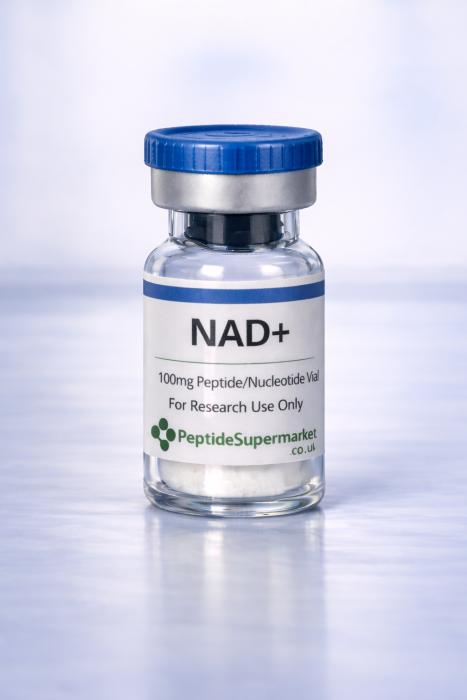
NAD+: the molecule behind cellular energy, aging, and why “just supplement it” often doesn’t work
Quick take
NAD+ isn’t a trendy add-on. It’s one of the core molecules that makes energy production possible. If NAD+ drops, ATP production becomes less efficient, recovery slows down, brain fog shows up, and the whole “I used to bounce back faster” problem starts to make sense.
But here’s the part most people miss: if your mitochondria are damaged, adding NAD+ precursors may do almost nothing, because converting precursors into usable NAD+ requires ATP — and ATP is the thing your mitochondria are struggling to produce.
Disclaimer
This is not medical advice. Before you put anything into your body, consult a licensed physician.
How your body makes ATP
Everything your body does requires energy, and that energy is ATP.
You store almost no ATP. You’ve got roughly 100 grams on hand at any moment — enough for only a few seconds of work — so your body has to remake ATP constantly, all day.
You make ATP through three main systems:
1) Glycolysis
Happens outside the mitochondria
Very fast (milliseconds)
Dominates during the first ~10 seconds of very intense anaerobic activity
Produces lactate as a byproduct, which is why you get that burning sensation when you sprint or lift heavy
2) The Krebs cycle
Happens inside the mitochondria
Takes the output of glycolysis and fully oxidizes it
This is where most NADH gets generated
3) The electron transport chain
Happens on the inner mitochondrial membrane
Uses NADH to pump protons and drive ATP production
This is where ~90% of your ATP comes from
So glycolysis gets you started fast, but most of your usable energy comes from mitochondrial metabolism.
Quick link: UK NAD+ price comparison (compare listings and pricing in one place):
What NAD+ is and why it matters
NAD exists in two forms:
NAD+ (oxidized form)
NADH (reduced form)
Here’s the loop:
NAD+ picks up electrons during metabolism → becomes NADH
NADH delivers those electrons to the electron transport chain
The chain uses them to make ATP
NADH gives up electrons → becomes NAD+ again
Repeat, thousands of times per day in every cell
If you don’t have enough NAD+ available, your cells can’t shuttle electrons efficiently, and ATP production slows down.
That NAD+/NADH ratio also matters. In healthy cells you see roughly 700 parts NAD+ for every 1 part NADH. When NAD+ is abundant, energy production is efficient. When NAD+ is scarce, energy becomes limited and cellular stress rises.
This is the difference between:
good endurance, clean recovery, mental clarity, easier fat loss
vsfatigue, brain fog, poor recovery, stubborn fat gain, afternoon crashes
Why NAD+ declines with age
NAD+ drops by about 50% every 20 years.
So by 40, you’re working with roughly half of what you had at 20.
Three major drivers:
NAD+ gets consumed more as you age because certain enzyme systems ramp up demand
NAMPT, a key enzyme involved in NAD+ production, becomes less efficient
Mitochondrial damage reduces your ability to recycle NAD+ effectively
When the system slows down, you feel it:
workouts feel harder
recovery takes longer
mental fatigue shows up earlier
fat loss gets harder, weight gain gets easier
And this isn’t just “feeling tired.” Lower NAD+ is linked with age-related problems like metabolic syndrome, diabetes, cardiovascular disease, and neurodegeneration patterns.
The catch: why NAD+ supplementation sometimes feels like nothing
If mitochondria are damaged, simply adding more NAD+ precursors can be self-limiting.
Converting precursors into usable NAD+ requires ATP. If ATP production is already compromised, your body may not be able to use the precursors effectively.
That’s why some people take NAD+ support and feel absolutely nothing — the machinery can’t use the fuel.
The three NAD+ production pathways
Your body makes NAD+ through three pathways, and every supplement approach feeds into one of these.
1) De novo pathway
Builds NAD+ from scratch using tryptophan
Slow and inefficient
Mostly a liver pathway
Not a practical target for supplementation
2) Preiss–Handler pathway
Converts niacin (vitamin B3) into NAD+
One of the most proven, cost-effective ways to raise NAD+
The downside is the niacin flush: red, hot, itchy skin for 20–30 minutes, which many people can’t tolerate
NMN and NR get discussed here too:
NMN is one step away from NAD+
NR converts into NMN inside cells, then becomes NAD+
Both avoid the flush, but they’re expensive, and the point made here is that a lot of oral NMN/NR gets converted into niacin in the gut anyway
3) Salvage pathway
Recycles nicotinamide back into NAD+
This is the main pathway your body relies on
Roughly 80% of NAD+ production runs through this route
The key enzyme here is NAMPT, and this is the one that becomes less efficient with age
This is also where 5-Amino-1MQ fits:
NNMT turns nicotinamide into waste that gets excreted
5-Amino-1MQ inhibits NNMT, reducing that drain so more nicotinamide stays available for recycling into NAD+
Direct NAD+ injection: why it’s different
Direct NAD+ injection bypasses the conversion steps.
You’re not feeding a pathway and hoping your body converts it — you’re putting NAD+ straight into the bloodstream.
This avoids:
gut conversion issues
niacin flush
So the logic is:
if you tolerate niacin flush, niacin is the cheapest proven option
if you don’t, direct NAD+ injection is the alternative that bypasses the bottlenecks
Repairing and optimizing mitochondria
If the core issue is damaged mitochondria, the solution isn’t only “more NAD+.”
Two peptides come into play in a specific order:
SS-31: repair
SS-31 supports mitochondrial repair by stabilizing the inner membrane. The point is fixing the machinery so ATP production can run properly again.
MOTS-C: optimize
Once the machinery is repaired, MOTS-C improves performance efficiency by activating AMPK, improving metabolic signaling, and increasing how well the system uses glucose and fuel.
So the sequence becomes:
repair the machinery (SS-31)
add fuel support (NAD+/niacin)
optimize the engine (MOTS-C)
Creatine: the ATP buffer people overlook
ATP is the goal, and you don’t store much of it.
Creatine supports the phosphocreatine system, which buffers ATP availability so you can access rapid energy quickly — and it also supports mitochondrial biogenesis.
That’s why it plugs into this whole energy conversation cleanly.
To compare NAD+ prices across UK listings, head over to our comparison hub:
The cellular energy protocol
This is a two-phase model.
Phase 1: Repair (weeks 1–8)
Goal: repair mitochondria and establish NAD+ production support.
SS-31 to repair mitochondrial membrane function
niacin (or NAD+ injection) to support NAD+ availability
5-Amino-1MQ to reduce precursor drain through NNMT
creatine to support the ATP system
Phase 2: Optimize
Goal: replace repair with optimization.
swap SS-31 out
add MOTS-C to optimize repaired mitochondria
continue niacin/NAD+, 5-Amino-1MQ, and creatine
Critical warnings and cycling
Chronic NAD+ precursor supplementation can suppress natural NAMPT production. Long-term use without breaks could leave you worse off when you stop.
So the rule here is cycling:
8–12 weeks on
4–8 weeks off
And don’t forget the lever that matters most:
Exercise increases NAMPT expression dramatically and raises muscle NAD+ significantly. Training, nutrition, and sleep stay the base layer no matter what.
Final takeaway
NAD+ matters because ATP matters. But if the mitochondria are damaged, “more NAD+” isn’t always the fix.
The model is:
repair the machinery
supply the fuel
optimize performance
cycle everything so you don’t suppress your own production
keep the foundation (training, sleep, nutrition, stress) locked in
If your foundation is solid and you’re still dealing with real energy decline and poor recovery, this is the kind of system that’s worth researching.
Compare NAD+ prices across the UK
Side-by-side prices from every trusted UK supplier stocking NAD+.


