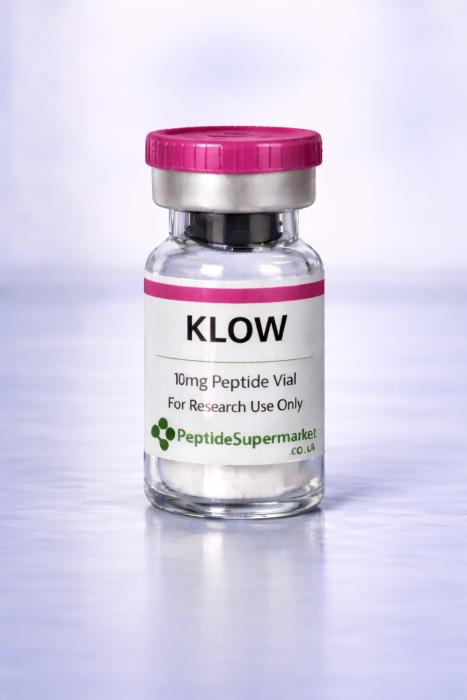
KLOW Combo
The 4-Peptide “Healing Stack” That Upgrades the Glow Protocol
Quick note: This is not medical advice. I’m not a doctor or a licensed medical professional. This article is for entertainment and educational purposes only. For any health questions or concerns, speak to a licensed professional.
If you’ve ever dealt with an injury that just won’t heal—nagging tendon pain, joint flare-ups, gut inflammation, skin issues, or that “I’ve tried everything and it still hurts” frustration—then you’ve probably run into the same problem everyone hits:
Most healing protocols work… partially.
That’s why the KLOW (often written “CLO/KLO”) combo has become one of the most popular blended peptide stacks in the research world. It’s basically the Glow combo—BPC-157 + TB-500 + GHK-Cu—with a fourth peptide added:
KPV, which is known for its anti-inflammatory signaling.
So in one vial, researchers are trying to cover four big categories at once:
Repair signaling (BPC-157)
Cell mobility + tissue recovery (TB-500)
Regeneration + collagen/skin/hair support (GHK-Cu)
Inflammation control (KPV)
Let’s break down what it is, how it works, and how people think about using it.
What Is The KLOW Combo
KLOW is a 4-peptide blend commonly used as an “all-in-one” healing stack:
BPC-157 (Body Protection Compound)
TB-500 (Thymosin Beta-4 fragment / TB-related research peptide)
GHK-Cu (Copper peptide complex)
KPV (a peptide fragment associated with alpha-MSH pathways)
It’s essentially an “upgrade” to the Glow combo by adding KPV, which is included specifically to target inflammation more directly.
Why are these combos becoming common? Simple:
Instead of juggling 4 separate vials and protocols, labs started combining peptides that synergize into one product—easier administration, easier compliance, and a unified goal: heal faster and recover better.
How Does It Work
Each peptide plays a different role, and the reason this combo exists is because the effects overlap and reinforce each other.
1) BPC-157: Repair signaling + angiogenesis
BPC-157 is often discussed as a broad “repair activator,” with research interest in:
connective tissue (tendons/ligaments)
gut lining support (gastric-associated origins are often mentioned)
organ protection and recovery pathways
the brain–gut axis (commonly discussed in peptide circles)
A big part of the “healing” narrative is its role in angiogenesis—supporting new blood vessel formation—because blood flow is one of the biggest bottlenecks in stubborn injury recovery.
2) TB-500: Cell movement + faster tissue recovery
TB-500 is commonly described as supporting:
cellular migration (often explained via actin binding)
tissue repair rate
immune cell movement toward injured sites
recovery support in muscles and joints
It’s frequently paired with BPC-157 because people frame it as:
BPC = “signal the repair”
TB-500 = “help the cells move and rebuild”
3) GHK-Cu: Regeneration + collagen + gene signaling
GHK-Cu is often positioned as more than “skin and hair,” because it’s discussed in relation to:
collagen remodeling
tissue regeneration
oxidative stress reduction
stem-cell-related signaling (often discussed in broad regenerative contexts)
systemic healing support beyond cosmetics
In stacks like Glow/KLOW, GHK-Cu is usually included to improve the quality of repair, not just the speed.
4) KPV: Inflammation control at the cellular level
KPV is included because it’s commonly described as:
targeting inflammatory signaling
entering cells and downregulating inflammatory pathways (often framed as “turning off the switch”)
In plain English: KPV is there to help reduce the chronic inflammation that keeps injuries “stuck” and prevents high-quality healing.
Why the stack makes sense
Put together, KLOW is basically aiming to do this:
reduce inflammation so healing can happen
improve circulation and nutrient delivery
accelerate tissue repair processes
support regeneration and collagen remodeling
That’s why people talk about it as a “full-body healing blend” rather than a single-purpose peptide.
If you’re researching KLOW and want to compare peptide prices in the UK, start here:
Benefits People Research This Combo For
Because the peptides overlap, people usually describe benefits as broad categories:
Accelerated tissue repair
Better recovery from training stress
Reduced inflammation
Improved wound / connective tissue healing
Support for joints, muscles, gut, skin, and hair
Neuroprotective/brain support (often discussed in the context of BPC + TB + KPV synergy)
One key idea that often comes up in these discussions:
These compounds are believed to “work where the body needs it most,” meaning injured tissue tends to “soak up” more of the benefit than healthy tissue—at least in how users interpret their outcomes.
Cautions & Contraindications
Common cautions people report
Water retention
Temporary fatigue/lethargy
Headaches
Injection site irritation
GHK-Cu burning sensation (reported by some; others don’t feel it)
Contraindications people commonly mention
This is where the language gets more conservative because the unknowns matter.
Many users suggest avoiding (or only researching under strict oversight) if you have:
Active infection
Autoimmune flare
Cancer / history of cancer
Not because anyone can prove these peptides will worsen those conditions—but because when you’re dealing with immune activation, malignancy risk, or infection dynamics, “healing signaling” can become a complicated game.
A common middle-ground stance is:
avoid during acute severe illness/flares
consider only after recovery/stability, if at all
involve medical oversight
Dosing & Cycling
Not medical advice—this is a summary of ranges people commonly discuss.
The biggest challenge with combo vials is obvious:
you can’t perfectly tailor each peptide if they’re pre-mixed.
A common vial format people mention is something like “10/10/50” style labeling (varies by lab), where GHK-Cu is typically higher than the others.
Common per-day ranges people discuss (individual peptides)
BPC-157: ~300–800 mcg
TB-500: ~300–1000 mcg
KPV: ~200–500 mcg
GHK-Cu: ~1–3 mg (1000–3000 mcg)
You’ll also see people discuss higher dosing when injuries are severe—but a smarter principle (and the one you referenced) is:
Start with the least effective dose, confirm tolerance, then scale.
Cycling frameworks people mention
daily use for 30–120 days, depending on goal
then a minimum 30-day break to reassess and avoid “just staying on everything forever”
The logic: once the problem is resolved, there’s no point continuing a “healing stack” unless there’s still something to heal.
Other Peptides People Stack With KLOW
If someone’s treating KLOW as the “healing base,” they sometimes add a second layer depending on the main goal:
For GH support / recovery
Tesamorelin + Ipamorelin
or CJC (no DAC) + Ipamorelin
For muscle recovery emphasis
PEG-MGF
IGF-1 LR3
For immune-focused research
Thymosin Alpha-1
LL-37
For nerve pain / neuropathy focus
ARA-290 (often discussed in that context)
For brain / stress / cognitive support
Semax
Selank
Cerebrolysin (often discussed in “brain repair” circles)
Big caveat: stacking gets messy fast. The more compounds you add, the harder it becomes to know what caused a benefit—or a side effect.
If you’re researching KLOW and want to compare peptide prices in the UK, start here:
Supplements People Often Pair With It
Common “support stack” ideas mentioned:
Collagen / bone broth protein (connective tissue support)
Creatine (performance + recovery) — but note: some avoid it if water retention is an issue
Natural diuretic (dandelion root / watermelon seed) for water retention
Minerals / electrolytes (especially if fatigue/cramping shows up)
NAD+ + glutathione (often mentioned as general cellular support)
Lifestyle Tools That Multiply Healing
The stack won’t outperform bad inputs.
Common “multiplier” habits people pair with KLOW:
Fasting (to reduce digestive load and support recovery focus)
Animal-forward, low-inflammatory eating (high-protein simplicity)
Corrective training (Tai Chi, rebounding, gentle movement capacity work)
Hot/cold exposure (sauna, cold plunge—doesn’t need extremes)
Light exposure (sunlight / red light)
Bodywork (massage, chiro, acupuncture)
HBOT / oxygen therapies (expensive, but frequently mentioned for healing acceleration)
Pros
Convenience: 4 peptides in one vial is dramatically easier
Well-known combo: these are among the most commonly discussed “healing” peptides
Broad application: joints, muscles, gut, skin/hair, inflammation, recovery—covers a lot of ground
Synergy: repair + regeneration + inflammation control in one protocol
Cons
Cost: 4 peptides = more expensive
Troubleshooting difficulty: if you react poorly, it’s harder to identify the culprit
Dosing rigidity: blends limit precision (especially with GHK-Cu usually being higher)
Complexity: reconstitution, dosing math, cycle planning—more advanced than single-compound use
My Honest Take
KLOW is the “premium” version of the classic healing stack because it adds KPV for inflammation control—so if someone is dealing with stubborn inflammation + slow healing, the concept is logically appealing.
That said, if someone wants the simplest and most time-tested entry point:
BPC-157 + TB-500 is still the OG healing combo.
KLOW becomes the move when:
you want a broader regenerative effect
you care about skin/hair/collagen quality as part of recovery
inflammation is a major limiting factor
you’re comfortable with blends and you’re willing to troubleshoot carefully
And if cost or complexity is too high, scaling back to the core two peptides is often the most practical path.
Compare KLOW Blend prices across the UK
Side-by-side prices from every trusted UK supplier stocking KLOW Blend.


