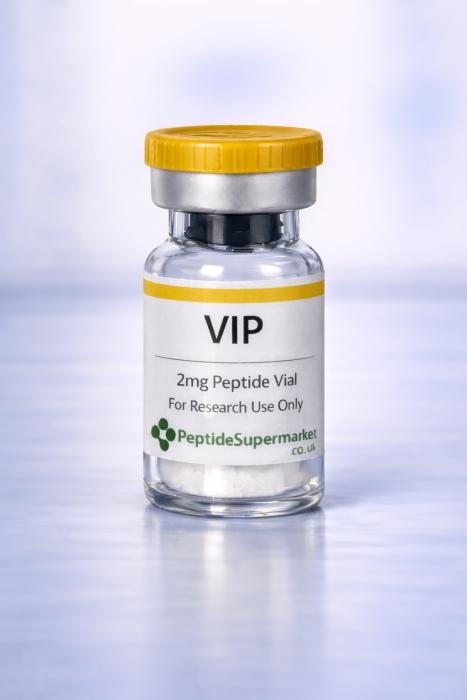
VIP
The Circulation & Immune “Regulator” Peptide People Use for Blood Flow, Lungs, and Neuro-Inflammation
Quick note: This is not medical advice. I’m not a doctor or a licensed medical professional. This article is for educational and entertainment purposes only. For any health questions or concerns, speak to a licensed professional.
Inflammation, cognitive decline, lung issues, cardiovascular strain—these are some of the most serious problems tied to poor circulation and immune dysregulation. And a lot of conventional options rely on medications that aren’t feasible for everyone long term.
That’s why VIP keeps coming up in neurology and immunology circles.
VIP stands for vasoactive intestinal peptide, and it’s one of those compounds that isn’t “just a peptide trend”—it’s a naturally occurring signaling molecule that affects blood vessels, smooth muscle, and immune response.
Let’s break down what VIP is, how it works, and how people think about using it.
What Is This Peptide
VIP (Vasoactive Intestinal Peptide) is found naturally in large amounts in:
the intestines
the pancreas
the brain
…and it’s present throughout the body in smaller amounts.
VIP is best understood as a movement and regulation signal:
it influences circulation (blood + lymph movement)
it affects smooth muscle tone (lungs, vessels, gut)
it modulates immune response and inflammatory signaling
it’s researched for neuroprotection and barrier support (especially the brain)
If you zoom out, VIP is a “system regulator” peptide—less like a direct healing peptide (BPC-style), and more like a functional switch that changes flow, tone, and immune signaling.
How Does It Work
VIP works by binding to receptors that are spread throughout the body:
VPAC1
VPAC2
PAC1
When these receptors are activated, VIP tends to produce a few major effects:
1) Vasodilation and smooth muscle relaxation
VIP helps relax blood vessels and relax smooth muscle, which can increase circulation and “open things up.”
That’s why it’s often discussed for:
blood flow and blood pressure regulation
lymphatic movement
erectile function (circulation-dependent)
respiratory support (smooth muscle in lungs/airways)
2) Immune modulation and inflammation control
VIP is also discussed as an immune “balancer.” It doesn’t just slam inflammation down like a harsh anti-inflammatory—people frame it as modulating immune response, helping reduce excessive inflammatory signaling.
3) Brain-related support via circulation and barrier effects
VIP is often talked about in the context of:
supporting the blood–brain barrier
improving cerebral circulation
neuroprotective signaling (less inflammatory load, better delivery)
The simple way to think about VIP
VIP is a peptide that:
opens flow (vessels + smooth muscle)
improves delivery (oxygen/nutrients via blood)
reduces inflammatory pressure (immune modulation)
That combination is why it shows up in discussions around lungs, sexual health, lymphatic congestion, and neuro-inflammation.
Benefits
Here are the main research benefits people associate with VIP:
Supports healthy blood flow and may help regulate blood pressure
Reduces organ inflammation and helps protect tissue from inflammatory stress
Respiratory support (COPD/asthma discussions), because smooth muscle relaxation can improve airflow mechanics
Brain support via blood–brain barrier protection and circulation effects
Improves circulation across systems: lymphatic, sexual, and respiratory systems
It’s a “circulation-first” peptide, and a lot of VIP’s downstream benefits come from the fact that better flow = better function.
Want to compare VIP prices in the UK? Use our Compare Peptide Prices UK hub:
Side Effects
Because VIP changes vessel tone and shifts circulation quickly, the most common cautions people report are:
nausea
headache
blood pressure changes
dizziness/lightheadedness
This usually gets explained as:
VIP “moves things” fast. That can be beneficial, but it can also be a shock if someone is sensitive to blood pressure or vascular changes.
Cautions
Extra caution is commonly advised for people who are on:
blood pressure medications
immune-modulating medications
Because VIP interacts with those systems.
Contraindications people commonly mention
pregnancy
uncontrolled blood pressure issues
Research Dosing & Cycling
Not medical advice — this is a summary of how people commonly discuss VIP use.
VIP is different from many peptides because it has an extremely short half-life—often described as around 2 minutes.
That changes the whole philosophy.
Common dose range people mention
100–500 mcg per dose
Cycling approach people talk about
Because it’s so short acting, VIP is commonly framed as:
as-needed use, when the goal is increased flow / relaxation / acute support
The theme you’ll hear a lot is:
Don’t become dependent. Use it as support, not a crutch.
If someone wants to run it more “protocol style,” you’ll sometimes see:
4–8 weeks on
2–4 weeks off
But overall, VIP is usually discussed more like a tool you use when you need the effect, rather than a long-term “build the tissue” compound.
Administration Forms
As the peptide market evolves, VIP gets used in multiple delivery formats:
1) Injection (systemic)
Often discussed as:
more systemic/full-body effect
typically lower dosing ranges like 100–300 mcg due to absorption efficiency
2) Nasal (often framed as more brain-targeted)
Commonly discussed as:
100–500 mcg
faster onset
more “CNS-forward” effect (because of proximity to brain pathways)
3) Nebulizing (lung-forward use)
This is often discussed for:
airway smooth muscle relaxation
respiratory-focused goals (COPD/asthma-style discussions)
This is one of the more interesting parts of VIP—different delivery methods map to different use-cases.
Other Peptides To Stack With
VIP is very “goal-dependent,” so stacking choices usually follow the category:
If the goal is healing/regeneration
BPC-157 + TB-500 + GHK-Cu + KPV (the KLOW/CLO combo)
VIP can be layered on top for circulation/flow support
If the goal is lungs/respiratory
LL-37 (immune-focused support, often discussed with lung relevance)
Bronchogen (bioregulator often discussed for lung tissue targeting)
VIP = “open/relax,”
LL-37/Bronchogen = “deeper immune + tissue support,” is how people rationalize that combo.
If the goal is sexual health / ED / fertility
PT-141
Kisspeptin
Oxytocin
VIP gets treated as the blood flow layer, and those peptides cover libido/arousal/fertility signaling.
If the goal is brain support
Cerebrolysin
Selank (and similar nootropic peptides)
Supplements To Stack This With
Since VIP’s theme is “open and move,” people usually pair it with circulation and foundational support:
Beetroot powder (NO pathway support + antioxidants)
Organ supplements depending on goal (lung, testicle, etc.—this is common in animal-based circles)
Collagen / bone broth protein (foundational tissue building blocks)
Creatine (muscle + brain support)
NAD+ + glutathione (general cellular support used across many stacks)
Lifestyle Tools
This matters more with VIP than most peptides, because VIP is often framed as symptom support, not root-cause fixing.
Good “root-cause” multipliers people pair with VIP:
Sunlight + sleep (baseline endocrine + recovery foundation)
Animal-based, low-inflammatory eating (simple, digestible fueling)
Rebounding (gentle lymphatic + circulation training)
Bodywork (massage, chiro, acupuncture — restores movement and flow)
Hot/cold contrast (circulation training)
HBOT / oxygen therapies (higher cost, often discussed for recovery)
If sexual health is the goal (men): shockwave therapy + pump work often gets mentioned as a mechanical foundation layer
The core idea:
VIP can “open the system,” but lifestyle determines whether the system stays open.
Pros
Fast acting and system-wide in how it relaxes vessels and smooth muscle
Holistic circulation effect (blood, lymph, lungs, sexual function support)
Multiple administration options (injectable, nasal, nebulized)
Cons
Very short acting (minutes), so it’s not a “set-and-forget” peptide
Often described as more symptom-focused than true regenerative/healing peptides
Can be more expensive relative to how long it lasts and how “deep” the effects feel for some users
For a UK-only VIP price comparison (so you can quickly compare listings), see: Compare VIP prices
Compare VIP prices across the UK
Side-by-side prices from every trusted UK supplier stocking VIP.


