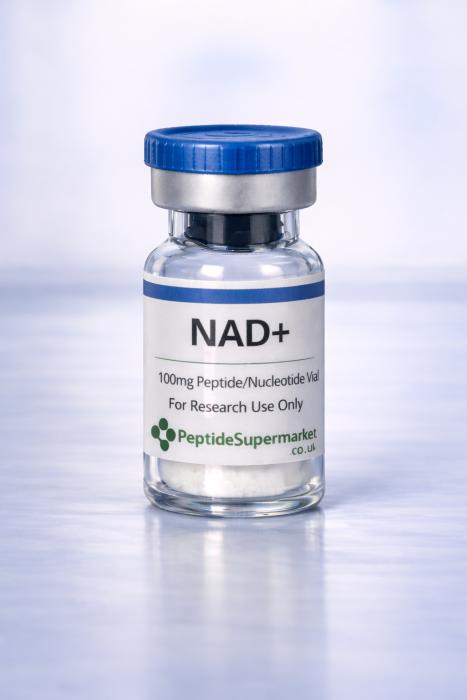
The Importance of NAD+ and Biochemistry
The real problem: your wiring is failing
Most people aren’t “just tired.” Your fuse is blown because you’re burning out the wiring in your biology.
The wiring is your mitochondria.
The insulation that protects that wiring is NAD+.
When NAD+ runs low, you’re basically running exposed, sparking, shorting-out circuitry. The end result is the same every time: you can’t produce energy efficiently, and everything downstream starts failing.
NAD+ is nicotinamide adenine dinucleotide. Big name. The consequences of not understanding it are bigger.
Your body runs on one currency: ATP
Your body is a dictatorship of ATP—adenosine triphosphate.
There is no other currency.
Every thought, every heartbeat, every breath, every muscle contraction, every immune response—everything is ATP-funded. And most people are trying to run this system on fumes.
Where NAD+ sits in the energy pipeline
Here’s the core mechanics.
Step 1: glucose gets broken down
Food becomes glucose.
Glucose gets broken down in the cytoplasm into pyruvate.
That pathway can keep you alive, but it’s inefficient. It’s messy. And if it becomes your default, you get a lot of metabolic “smoke.”
Step 2: pyruvate wants into the mitochondria
Pyruvate wants into the mitochondria because that’s where the real power plant is.
But it has to pass through the pyruvate dehydrogenase complex (PDC)—the turnstile.
And the bouncer at that turnstile is NAD+.
No NAD+, no entry.
When pyruvate can’t get in, it gets diverted into fermentation pathways and you accumulate more metabolic waste.
Step 3: once inside, you activate the Krebs cycle
If pyruvate gets in, it becomes acetyl-CoA, and now you’re running the Krebs cycle (citric acid cycle).
The cycle exists to strip electrons off molecules and load them onto carriers.
That’s where NAD+ is non-negotiable: it accepts electrons and becomes NADH.
If NAD+ isn’t available, those reactions stall. The cycle sits idle.
Step 4: NADH feeds the electron transport chain
NADH then dumps electrons into Complex I of the electron transport chain on the inner mitochondrial membrane.
That electron flow forces proton pumping across the membrane and builds a massive proton gradient—stored potential energy.
Step 5: the turbine makes ATP
The gradient is released through a molecular turbine: ATP synthase.
Protons rush back through it, the rotor spins, and the force slams a phosphate onto ADP to form ATP.
That conversion—oxidative phosphorylation—is the difference between barely scraping by and running like a juggernaut.
And here’s the choke point again:
No NAD+ → no NADH → no electrons → no gradient → no turbine spin → no ATP.
That’s why NAD+ is a big deal.
If your goal is simply to compare NAD+ prices (UK), use our dedicated comparison page:
NAD+ isn’t just energy. It’s damage control.
NAD+ has another job that matters just as much: keeping you from falling apart.
It activates sirtuins—emergency response proteins that run your internal maintenance systems.
The way this is presented:
SIRT1: supports DNA repair signals and pushes mitochondrial-building programs
SIRT3: works inside mitochondria to tighten efficiency and reduce energy leakage
SIRT6: reinforces genomic stability and protects the aging machinery tied to chromosome caps
This is your management crew: the system that keeps your cellular “city” running, fixing damage, maintaining efficiency, and preventing total infrastructure collapse.
When NAD+ is depleted, these systems go offline. Not because they’re broken—because they’re unpaid.
What NAD+ depletion looks like in real life
Low NAD+ isn’t subtle. It’s system-wide failure.
Brain
Neurons are energy hogs. When ATP production drops:
neurotransmission slows
plasticity fails
toxins and debris accumulate
What people call brain fog is framed here as early-stage neurological decay driven by energy failure.
Muscles
Fast-twitch performance and recovery fall apart first:
you lose power
recovery slows
you accumulate fatigue faster
you can’t generate clean output
This shows up as “aging,” but it’s fundamentally an energy shortage problem.
Metabolism
Without ATP, metabolic control degrades:
glucose handling becomes dysfunctional
storage increases because burning capacity collapses
the system shifts toward inefficient output
Immune system
Immune cells need huge amounts of ATP to mobilize, signal, and execute responses.
Low NAD+ is framed as a sluggish, underpowered immune response:
you catch everything
you can’t clear infections cleanly
you feel run down for longer than you should
Why oral NAD+ is treated as a dead end
NAD+ as an intact molecule is described as a poor fit for oral delivery:
it’s large
it’s charged
it gets dismantled by digestion into components before it can function as NAD+ systemically
That’s why precursors exist.
The precursor logic: NMN
NMN is presented as a less-direct approach: a precursor your body can convert into NAD+.
But the conversion itself isn’t free:
conversion requires functioning enzymes
conversion is energy-dependent
and energy is the thing you’re already short on
So the framing is: oral NMN is often paying for the hope of conversion rather than guaranteeing results.
Want to compare NAD+ prices in the UK? See our NAD+ price comparison page here:
The delivery method that’s presented as rational
The approach described as direct is subcutaneous delivery of NAD+—bypassing digestive breakdown and delivering the intact molecule into circulation.
The point isn’t hype. It’s mechanics: if you want the molecule to function as NAD+, it has to arrive intact.
What happens when NAD+ is restored
The effects are framed as a full operating-system reboot:
cognitive clarity sharpens
processing speed increases
memory recall becomes easier
physical energy and endurance rise
metabolism shifts toward cleaner energy production
insulin sensitivity improves
repair systems activate: DNA repair, mitochondrial cleanup, inflammatory tone reduction
This isn’t presented as a “stim” feeling. It’s infrastructure functioning again.
Practical use pattern
The practical pattern described is simple:
2–3 times per week
maintain the upgraded baseline
framed as physiological replacement rather than a complicated cycling strategy
NAD+ as a multiplier for everything else
The core idea: NAD+ doesn’t just do its own job—it makes other interventions work better because it restores the energy base.
If you don’t have energy, the rest doesn’t matter. No gas in the tank means performance parts don’t help.
So NAD+ is treated as foundational infrastructure:
build energy first, and the system can actually execute repair, adaptation, and performance.
Bottom line
NAD+ isn’t a trend. It’s a central control molecule for:
mitochondrial energy production
cellular maintenance and repair
system-wide resilience
When NAD+ drops, you don’t “age.” You become energy-bankrupt.
When NAD+ is restored, your body can finally do what it was built to do: produce ATP, repair damage, and run the machine at full capacity.
Compare NAD+ prices across the UK
Side-by-side prices from every trusted UK supplier stocking NAD+.


