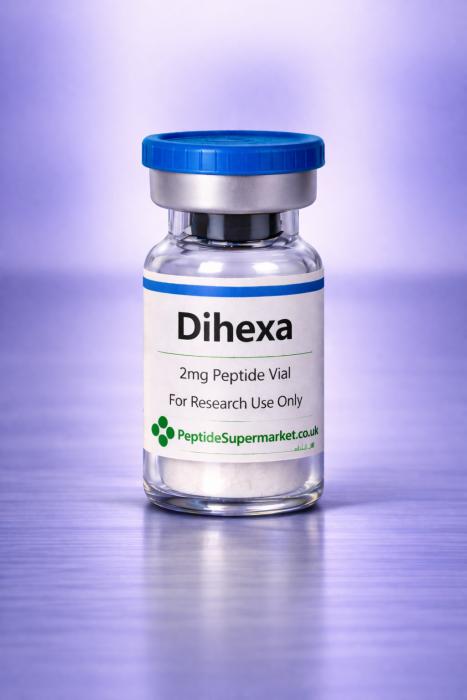
Dihexa attracts attention because it sits at the intersection of memory, learning and brain plasticity. In peptide discussions, it is often presented as something more ambitious than a short-acting nootropic. Rather than being framed as a temporary stimulant, it is usually discussed in relation to structural and signalling changes inside the brain.
That distinction is a large part of why it has become such a talking point. The idea is not simply sharper focus for a few hours. The idea is a peptide explored in relation to the pathways that support long-term adaptation.
What Dihexa is usually described as
Dihexa is commonly described as an angiotensin IV analogue discussed for its potential effects on cognitive function and neuroplasticity. In early research conversations, it is often linked to memory formation, learning capacity and synaptic signalling rather than to a purely stimulant-style effect.
That framing matters because it sets expectations. People do not talk about Dihexa in the same way they talk about caffeine or a fast nootropic stack. They usually talk about it as a peptide tied to deeper brain mechanisms.
Why it stands out in peptide conversations
One reason Dihexa gets so much attention is its reported ability to cross the blood-brain barrier. In practical terms, that means it is often discussed as being able to reach brain regions that are harder for many compounds to influence directly.
For a UK-only Dihexa price comparison (so you can quickly compare listings), use our hub:
The second reason is the way it is linked to c-Met signalling and neurotrophic activity. Preclinical and mechanistic discussions often focus on synaptic density, dendritic spine formation and the possibility of stronger neural connectivity. That is the language that gives Dihexa its reputation for being more than a conventional cognitive enhancer.
The kinds of benefits people discuss
Dihexa is often discussed in relation to memory acquisition, recall, learning speed, mental stamina and conversational fluency. Some discussions also extend into mood, motivation and resilience under cognitive strain.
The important point is that these ideas do not all sit on the same level of evidence. Some belong more clearly to early research and mechanism. Others are largely anecdotal or drawn from broader peptide culture. A careful article should keep those categories separate.
Why neuroplasticity is the real story
The strongest reason people stay interested in Dihexa is the neuroplasticity angle. Unlike compounds that are mainly described as increasing alertness, Dihexa is often discussed as supporting the conditions for new connections and neuronal adaptation.
That is also why it keeps showing up in conversations around age-related cognitive decline and complex learning. The appeal is not merely feeling switched on. It is the possibility of making the brain more adaptable over time.
The disease-related claims need restraint
Dihexa is often mentioned alongside conditions such as Alzheimer’s disease, Parkinson’s disease, traumatic brain injury and post-traumatic stress. Those associations help explain why the peptide sounds so compelling.
Before you buy Dihexa, it’s worth checking a UK price comparison first. We keep a running list here:
They also need careful wording. Preclinical and early-stage discussions may explore these areas, but that should not be turned into a claim that Dihexa is an established treatment. A peptide can be biologically interesting in serious neurological conditions without being clinically settled.
Why expectations should stay realistic
This is where Dihexa often gets oversold. A peptide tied to memory, motivation and brain repair can quickly become wrapped in grand language. The better reading is more measured.
Dihexa is best understood as a peptide being explored in relation to neuroplasticity and cognitive signalling, with promising theory and intriguing early research, but without the kind of complete clinical story that would justify certainty.
Final thoughts
Dihexa remains one of the more fascinating compounds in peptide discussion because it is framed around adaptation rather than stimulation. That alone makes it worth understanding.
For readers comparing peptides uk options, this is also a reminder that identity and realism matter more than hype. Anyone wondering where to buy peptides or planning to buy peptides uk should be cautious with cheap peptides language around a compound this specialised. A peptide supplied uk source should describe Dihexa with restraint, not exaggeration.
Compare Dihexa prices across the UK
Side-by-side prices from every trusted UK supplier stocking Dihexa.


