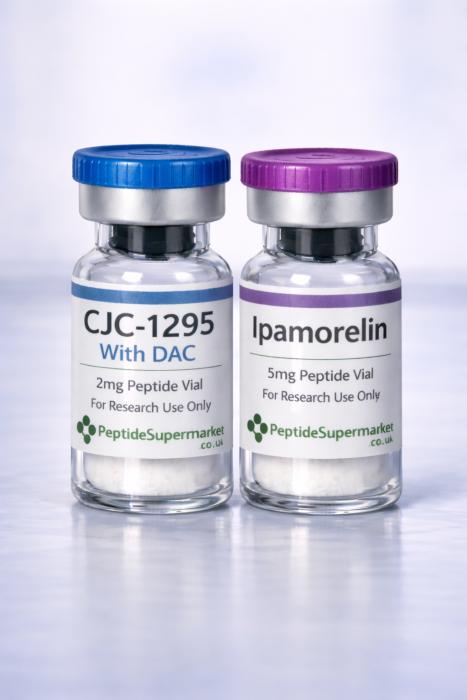
CJC-1295 With DAC + Ipamorelin
This is the “why these two are married” masterclass.
Not because they’re magic.
Because they plug into two different control knobs of the same system—your growth hormone (GH) pulse generator.
And GH isn’t just about “getting jacked.” It’s one of the core signaling systems tied to:
body composition (lean mass vs fat mass)
connective tissue turnover and recovery
sleep architecture and repair windows
immune vigilance
metabolic flexibility (how well you handle fuel)
The Role of Growth Hormone in Aging
People get taught that:
aging is inevitable
getting sick all the time is “normal”
decline is just what bodies do
But physiologically, a lot of “aging” symptoms are signaling decline plus system breakdown—especially when:
inflammation rises
insulin sensitivity drops
mitochondrial energy output falls
GH signaling is one of the levers that can shift the system toward repair instead of toward breakdown.
The Pituitary Control System
Your pituitary gland is a small organ with an outsized job: it coordinates a lot of endocrine output—especially GH.
The hypothalamus runs the pituitary using two opposing signals:
GHRH (growth hormone releasing hormone) = “GO”
Somatostatin = “STOP”
GH is not meant to be flatline constant.
It’s supposed to be pulsatile—waves of release (especially during deep sleep and after hard training).
That pulsatility matters because the body adapts differently to:
natural rhythmic signaling vs
constant exposure
This is one reason people draw a distinction between stimulating your system vs replacing it with a constant external signal.
Looking to compare CJC-1295 With DAC prices (UK)? Our price comparison hub puts the listings in one place:
Why Pulsatility Matters
GH pulses are part of the body’s built-in “repair scheduling.”
Pulses line up with:
tissue remodeling
recovery signaling
substrate partitioning (where calories end up going)
downstream IGF-1 dynamics
Flatten the rhythm and the biology changes—often in ways you don’t want.
Mechanisms of CJC-1295 and Ipamorelin
CJC-1295: A GHRH Pathway Driver
CJC-1295 is designed to mimic GHRH-like signaling (the “GO” input to the pituitary).
The key idea: extend the useful signaling window compared with native GHRH, which is rapidly broken down in the body.
The DAC Difference
DAC (Drug Affinity Complex) is essentially an engineering move: it helps the molecule bind albumin (the most abundant blood protein).
Practically, that tends to mean:
longer persistence in circulation
longer stimulation window
less “blink-and-you-miss-it” signaling
So the contrast is usually framed like this:
CJC without DAC → shorter window, more frequent administration required to maintain effect
CJC with DAC → longer window, more consistent week-long-ish stimulation pattern
(Important note: real-world half-life, effect duration, and response vary a lot by person, product quality, and measurement method.)
Ipamorelin: A Ghrelin-Receptor Pathway Driver
Ipamorelin works through a different upstream trigger:
it targets the ghrelin receptor pathway (GHSR1a)
Ghrelin is often called the “hunger hormone,” but that’s oversimplified—ghrelin signaling is also tied to:
GH release
metabolic coordination
sleep and circadian-adjacent signaling
Ipamorelin is typically described as more selective than some other ghrelin-mimetics, aiming for GH stimulation with fewer off-target endocrine effects (though “fewer” is not “none”).
Why They’re Married Together
Here’s the entire reason people stack them:
CJC-1295 and Ipamorelin stimulate GH release through different receptor systems in the same organ.
CJC-1295 → GHRH receptor pathway
Ipamorelin → GHSR1a (ghrelin receptor) pathway
That creates three practical advantages (in theory and in some human data, but results vary):
More receptor sites activated
More “doors” open at once → a bigger signal.Convergent signaling amplification
Both pathways push intracellular signaling that promotes GH release—through overlapping but distinct routes.Less “one-pathway burnout”
Hammer one pathway and the body can adapt fast. Two-pathway stimulation may reduce the “single lever tolerance” problem.
So it’s not just “add two things.”
It’s two different control inputs creating a stronger coordinated output.
Growth Hormone and Longevity
Downstream of GH pulses you get changes in IGF-1 signaling (systemic and local), and that ties into:
protein synthesis regulation
tissue remodeling capacity
recovery bandwidth
mitochondrial biogenesis signaling (via pathways that influence PGC-1α activity)
antioxidant enzyme expression patterns
cellular cleanup balance (autophagy/anabolism interplay)
The important nuance:
Physiological-range signaling ≠ supraphysiological exposure.
People blur that line constantly and then wonder why outcomes diverge.
What This Can Influence in the Body
Muscle and Tissue Remodeling
GH/IGF-1 signaling can support:
increased protein synthesis signaling
satellite cell activity (muscle repair/regrowth capacity)
reduced breakdown pressure (context-dependent)
This is why GH secretagogue-style approaches are often framed as “recovery and composition tools,” not just vanity drugs.
Immune Function
GH and IGF-1 interact with immune signaling. Aging tends to reduce immune responsiveness; GH-related signaling is one lever that can shift immune function markers in some contexts.
Cognition and Brain Support
GH/IGF-1 signaling interacts with neuronal survival pathways, neuroplasticity signaling (BDNF-related dynamics are often discussed), and general “brain energy” capacity—again, context-dependent and not magic.
Cardiovascular and Renal Signaling
GH/IGF-1 signaling affects endothelial function and repair signaling pathways. Whether that becomes beneficial or problematic depends heavily on dose dynamics, baseline risk, and overall metabolic state.
If you’re researching CJC-1295 With DAC and want to compare peptide prices in the UK, start here:
The Cancer Fear: What’s Actually the Nuance?
People often reduce the conversation to: “GH/IGF-1 = cancer.”
Reality is more nuanced:
Cancer development is multi-hit: mutations + immune evasion + inflammatory environment + metabolic dysfunction.
Chronically high, pathological growth signaling is not the same thing as restoring physiological signaling.
IGF-1 is a growth signal, but the system includes binding proteins and counterbalances; the context matters.
That said:
If someone has a history of cancer, unexplained growths, or high-risk conditions, this is not a DIY playground. It’s clinician territory.
Practical Reality Check
These compounds are not “just peptides.” They’re endocrine signaling tools.
Key risks / considerations include:
glucose handling shifts (especially if baseline insulin resistance exists)
edema, paresthesias, carpal-tunnel-type symptoms (seen with GH-axis manipulation)
appetite changes (more common with some ghrelin-axis compounds)
prolactin/cortisol effects (varies by compound and person)
IGF-1 elevation beyond a healthy range
interactions with thyroid status and other hormone axes
If someone is using GH-axis tools responsibly, they usually monitor basics like:
IGF-1
fasting glucose + HbA1c
lipids
blood pressure
thyroid panel (TSH, free T3/T4) if symptomatic
sleep quality and recovery markers
Not as “biohacker cosplay”—as basic risk management.
How This Fits the Bigger Model
If you zoom out, GH-axis optimization is not a stand-alone “longevity operating system.”
It’s a lever that works best when the foundations are addressed:
systemic inflammation down
insulin sensitivity up
mitochondrial ATP production supported
Because your endocrine signals don’t operate in a vacuum—your metabolic terrain determines whether signals create repair or chaos.
Bottom Line
CJC-1295 with DAC + Ipamorelin is a “marriage” because it:
stimulates GH release through two complementary upstream pathways
supports more robust, more coherent GH pulsatility
tends to avoid the “one lever only” limitation
Used intelligently, it’s often positioned as a recovery + repair + composition toolset.
Used recklessly, it becomes endocrinology roulette.
Biology doesn’t care what the internet says.
Compare CJC-1295 with DAC prices across the UK
Side-by-side prices from every trusted UK supplier stocking CJC-1295 with DAC.


