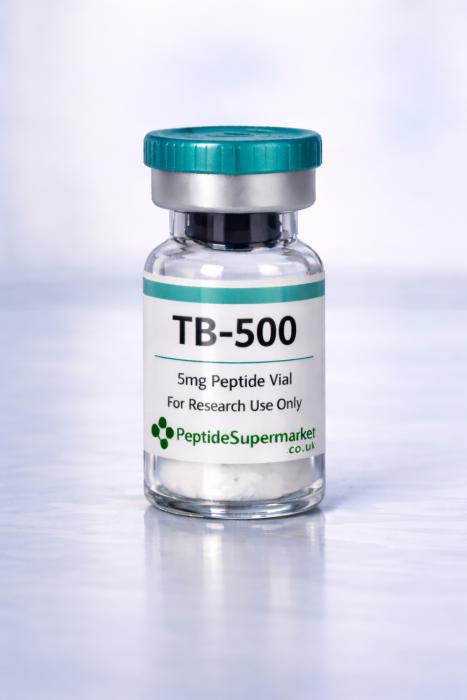
What TB-500 actually is
TB-500 isn’t a “drug.” It’s a signal—a message your body already understands.
But there’s a huge point of confusion that ruins results:
Thymosin Beta-4 (TB-4) is the full-length molecule (43 amino acids).
TB-500 is a short, highly active fragment (commonly referenced as ~17 amino acids) that carries the core “get up and repair” message in a tighter, more stable package.
Think of TB-4 as the whole book. TB-500 is the chapter that contains the plot.
The reason this matters is simple: size and stability change how cleanly and effectively the message lands. TB-500 is small, stable, and fast—built for delivery.
What TB-500 does in the body
Your cells communicate using peptides and proteins. When tissue gets damaged, the local environment throws up flares: help needed. TB-500 amplifies that repair signal and pushes four major instructions:
1) Move
TB-500 interacts strongly with actin—a structural protein in the cellular “skeleton.”
That matters because actin controls mobility.
Result: TB-500 tells key repair cells to migrate to the injury site:
mesenchymal stem cells
endothelial cells (blood vessel lining cells)
This is how you get repair where you need it instead of “general improvement” that never shows up in the tissue that’s actually broken.
2) Build supply lines
No healing happens without blood flow. Period.
TB-500 drives angiogenesis—the creation of new blood vessels—so nutrients and oxygen can get in and metabolic waste can get out.
That’s not a “bonus.” It’s a requirement for repair.
3) Don’t die
In injury, cells often get pushed toward apoptosis (programmed cell death).
TB-500 sends a strong anti-apoptotic signal—basically: hold the line, help is coming.
This preserves scaffolding so the body can repair instead of rebuild from rubble.
4) Shut the inflammatory chaos down
Acute inflammation is part of repair. Chronic inflammation is collateral damage.
TB-500 helps dial down the inflammatory cytokine storm so the repair process can proceed with less destruction.
To compare TB-500 prices across UK listings, head over to our comparison hub:
The most powerful application: the heart
Most people think TB-500 is “just” for soft tissue.
The hardest-hitting application is myocardial tissue.
When the heart is damaged, the default outcome is scar (fibrosis): stiff, non-conductive, mechanically weaker tissue. That scar disrupts function and electrical signaling.
TB-500 targets this by shifting gene expression and remodeling pathways:
Downregulates pro-fibrotic signaling
Upregulates remodeling enzymes (MMPs) that help break down excess collagen
Supports formation of healthier, functional tissue architecture
That has implications for:
reduced fibrosis
improved ventricular function
cleaner electrical conduction (less “static” in the signal)
Athlete’s heart and rhythm problems
Long-term high-intensity training can enlarge the heart and thicken walls. Over time, fibrosis can develop and interfere with conduction, increasing arrhythmia risk.
By supporting fibrosis remodeling and healthier conductive tissue environments, TB-500 is positioned as a tool for addressing the structural piece of that problem.
(Not every arrhythmia is the same. Rhythm issues can have multiple drivers. The structure is one piece.)
Other major uses TB-500 covers
TB-500’s core mechanisms show up everywhere tissue repair is limited by blood flow, inflammation, and cell migration:
Kidney injury support (high vascular demand, ischemia sensitivity)
Tendon and ligament repair (slow-healing tissues with poor blood supply)
Peripheral nerve support (neurite growth/guidance + anti-inflammatory effects)
Chronic non-healing wounds (angiogenesis + cell migration to finally close tissue)
Practical rules that decide whether TB-500 works
1) Oral TB-500 isn’t a thing
If it isn’t injected into subcutaneous tissue, it doesn’t work.
2) You cannot microdose TB-500
TB-500 is dose-dependent and requires a threshold concentration to initiate the full signaling cascade.
A microdose is like whispering into a hurricane. You don’t hit critical mass, so the signal never becomes a meaningful physiological event.
3) Blends are a scam (especially anything with copper)
You’ll see “all-in-one” vials claiming TB-500 + BPC-157 + GHK-Cu in a single mix.
That’s chemically and practically incompatible because:
peptides have different stability profiles
different optimal pH ranges
different reconstitution needs
different half-lives and timing
and copper ions can degrade peptides in solution
If you want synergy, keep them separate and run them intelligently.
Pricing for TB-500 can vary, so we’ve put together a UK price comparison hub here:
Dosing framework and cycling (hypothetical research model)
TB-500 should be pulsed, not dripped in constantly. The body adapts fast to constant signaling.
A straightforward approach:
5–10 mg every 5–7 days (threshold dosing, not microdosing)
Run 4–6 weeks (or 6–8 weeks)
Take 4–6 weeks off
Repeat as needed
This gives the stimulus, then lets the system integrate the structural changes.
TB-500’s best partner: BPC-157
The combination isn’t just “additive.” It’s synergistic.
BPC-157 drives repair support and vascular signaling.
TB-500 directs cellular migration and orchestrates rebuilding where the damage is.
One builds the roads and supplies. The other directs traffic and gets the crew on site.
A simple long-term “tissue + vascular” stack (hypothetical model)
If the goal is prevention, repair capacity, and clean systemic function, this is a clean framework:
TB-500: twice per week for 6 weeks → off 6 weeks → repeat
BPC-157: 250–500 mcg daily (ongoing endothelial + repair support)
GHK-Cu: 2–3 mg daily (dilute to tolerance; keep separate from other peptides)
MOTS-C: 2.5–5 mg every other day (mitochondrial/ATP support)
Retatrutide: metabolic load reduction (body composition, lipids, systemic stress reduction)
Keep reconstitution separate. Keep injections separate. Keep copper away from your other peptides.
The bottom line
TB-500 is a repair command signal—not a stimulant, not a gimmick, not a “feel-good” compound.
It pushes four instructions your body needs to heal like it used to:
migrate repair cells
build blood supply
prevent unnecessary cell death
bring inflammation back under control
And its biggest upside isn’t cosmetic recovery—it’s structural repair where modern systems usually surrender: fibrosis and tissue remodeling, especially in the heart.
Compare TB-500 prices across the UK
Side-by-side prices from every trusted UK supplier stocking TB-500.


