Live prices from 134 UK suppliers, from £9.80, compared side by side so you never overpay.
Copy the code — you'll paste it at checkout.
with our exclusive code
You're about to visit an external supplier
with our exclusive code
By clicking "Continue", you acknowledge that you understand and accept the above. Read our full disclosure.
Try removing a filter or two to widen the search.
Try removing a filter or two to widen the search.
More ways to compare Epitalon
Different views of the same live UK pricing, tuned for how you like to shop.
Compare another peptide
All purchases are made directly from third-party suppliers; your relationship is solely with them. We accept no liability for the quality, purity, or legality of any products listed.
We may earn a commission when you click through to a supplier and make a purchase. This does not affect pricing information displayed.
By using this site you accept responsibility for ensuring purchases comply with applicable laws in your jurisdiction. Read our full disclosure.
Synthetic Pineal Tetrapeptide | Telomerase Activator
Epitalon is a synthetic tetrapeptide developed by Russian scientist Vladimir Khavinson with 35+ years of research. It activates telomerase at extremely low concentrations to maintain telomere length, stimulates melatonin production, and modulates gene expression through epigenetic mechanisms.
Activates telomerase at extremely low concentrations (10⁻¹⁷ to 10⁻¹⁵ M) to maintain telomere length, stimulates melatonin production from the pineal gland, and modulates gene expression through epigenetic mechanisms.
AEDG
Alanine
Position 1
Glutamic Acid
Position 2
Aspartic Acid
Position 3
Glycine
Position 4
Activates telomerase at microgram doses to extend telomeres and cellular replicative lifespan.
Reverses aging markers and improves mitochondrial function at the cellular level.
Animal studies show 25-33% lifespan increases using 30-40mcg/kg doses.
Restores pineal gland function and circadian melatonin rhythm in elderly.
Supports new neuron formation at nanogram concentrations.
90% response rate for retinal degeneration at 5mcg per eye dosing.
Supports thymus gland regeneration for improved immune function.
Enhanced immune surveillance and countering of immunosenescence.
Subcutaneous injection is the primary and most researched route. Short cycles of 10-20 days with 4-6 month breaks between cycles.
| Goal | Dose | Frequency | Route |
|---|---|---|---|
| Standard anti-aging | 200-500mcg | 1x daily for 10-20 days | SubQ |
| Conservative start | 100mcg | 1x daily for 10-20 days | SubQ |
| Russian clinical equivalent | 300mcg | 1x daily for 10-20 days | SubQ |
| Ultra-low dose | 50mcg | 1x daily for 10-20 days | SubQ |
Intranasal spray offers non-invasive administration with potentially faster absorption, though less research data available.
| Goal | Dose | Frequency | Route |
|---|---|---|---|
| Nasal administration | 1-2mg daily (corrected from traditional 5mg) | 1x daily for 10-20 days | Nasal spray |
Oral administration has reduced bioavailability due to digestive breakdown. Less predictable effects compared to injectable.
| Goal | Dose | Frequency | Route |
|---|---|---|---|
| Oral administration | 2-3mg | 2x daily for 10-20 days | Oral |
Both work through pineal pathways; may enhance circadian rhythm effects.
Enhanced immunomodulation - commonly combined in Russian protocols.
Different anti-aging pathways; complementary mechanisms.
Different axis activation; no known interactions.
Different regenerative mechanisms.
Both are neuroprotective; monitor for cumulative effects.
Different neurocognitive focus.
Telomerase activation may theoretically affect malignancy; avoid with active cancer.
Subtle energy improvement possible
Better sleep quality, vivid dreams (melatonin effect)
Enhanced morning energy, mood stability
Skin quality improvements, enhanced wound healing
Laboratory markers may show telomere changes
Cumulative anti-aging benefits with repeated cycles
Mechanisms of ageing and development · Anisimov VN, Khavinson VK, Mikhalski AI, Yashin AI
This mouse study examined synthetic thymic and pineal peptides, including Epitalon-related pineal peptide exposure, and reported age-associated biomarkers, survival, and spontaneous tumor incidence.
Biogerontology · Anisimov VN, Khavinson VKh, Popovich IG, Zabezhinski MA, Alimova IN, Rosenfeld SV, Zavarzina NY, Semenchenko AV, Yashin AI
This study administered Epitalon to female Swiss-derived SHR mice and reported measurements of aging biomarkers, lifespan, and spontaneous tumor incidence.
Bulletin of experimental biology and medicine · Khavinson VKh, Bondarev IE, Butyugov AA
This in vitro study exposed human somatic cells to Epitalon and reported changes in telomerase activity and telomere length.
Plain-English guides and study summaries from published literature.
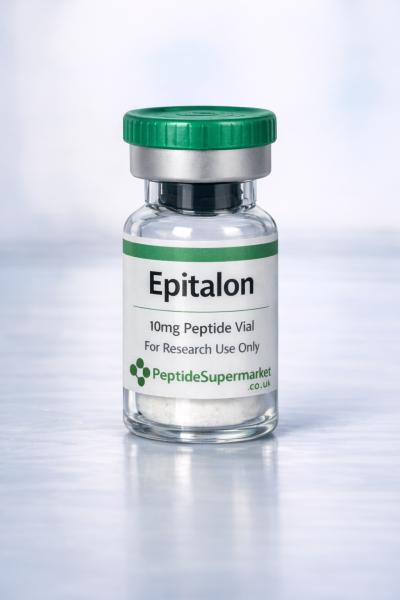 Guides
5 min
Epithalon — why sleep and recovery decline after 40, and the peptide aimed at reversing the slide Quick take If your sleep gets worse every year after 40 and your recovery takes longer, those aren’t separate problems. Two systems have been declining since your 20s: Telomeres (the cellular “age clock” that limits how long cells can keep dividing) The pineal gland (melatonin output and circadian rhythm that drives nighttime recovery).
Read article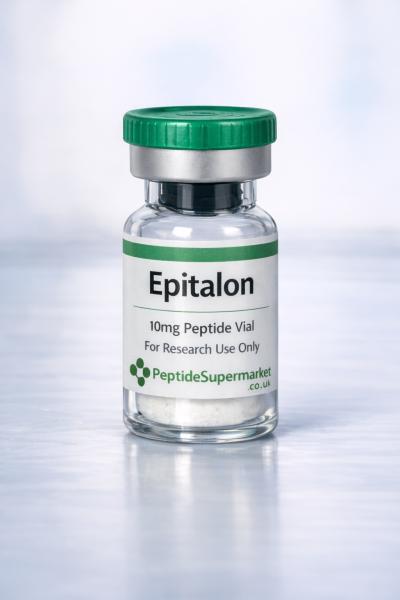 Guides
6 min
The Power of Epitalon Epitalon is a longevity signal. Not “live longer hooked to a machine” longevity—actual capacity longevity: staying sharp, staying mobile, staying powerful while the clock keeps moving. Epitalon is about pulling back the script on why cells age, why tissue loses function, why systems degrade—and then putting a thumb on the scale in the opposite direction.
Read articleBe the first to know when prices drop on your favourite peptides
No spam. Unsubscribe anytime. We respect your privacy.