The Importance of Mitochondria
Everything comes back to the same three biological failures:
Systemic inflammation
Insulin resistance
ATP shortage
And here’s the part people keep missing:
Inflammation and insulin resistance don’t just “coexist” with low energy.
They cause the ATP shortage—because they break the mitochondria.
When mitochondria fail, you get sick.
When they fail catastrophically, you die.
Not poetic. Not motivational. Mechanistic.
The Mitochondria Myth: “Powerhouse of the Cell” Is an Insult
Calling mitochondria “powerhouses” is kindergarten-level shorthand.
Mitochondria are:
the energy engine
the metabolic command center
the life/death switchboard (apoptosis)
the redox signaling hub
the calcium regulator
the stress-response coordinator
They’re not just producing ATP.
They’re deciding whether your cells repair, adapt, survive… or self-destruct.
When the command center collapses, the whole operation collapses.
Understanding Mitochondrial Dysfunction
Your body runs on one currency: ATP (adenosine triphosphate).
No ATP:
no muscle contraction
no heartbeat
no nerve firing
no recovery
no cognition
no immune function
no tissue repair
no resilience
Mitochondria generate the vast majority of ATP via oxidative phosphorylation—the most efficient energy system biology has.
But when ATP demand outstrips ATP supply, your body makes brutal triage decisions.
Think of it like a rolling blackout:
hospitals and police stations keep power
suburbs go dark
In your body, the “suburbs” are:
collagen repair
immune surveillance
higher cognitive function
That’s why people experience “aging” as:
sagging skin and achy joints
frequent illness
brain fog and slower thinking
That’s not “normal aging.”
That’s managed energy failure.
If you’re researching MOTS-C and want to compare peptide prices in the UK, start here:
How the Three Biological Failures Break Mitochondria
1) Systemic inflammation = the arsonist
Chronic inflammation isn’t abstract.
It’s a constant cytokine fire—driven by things like:
poor diet patterns
chronic stress
environmental toxins
gut dysbiosis / barrier dysfunction
Those inflammatory signals damage mitochondrial membranes and mitochondrial DNA, and they interfere with the electron transport chain.
Translation:
Inflammation is the arsonist setting fire to the power plant.
2) Insulin resistance = fuel trucks stuck outside the power plant
Insulin is the “key” that opens the door for glucose to enter cells.
Glucose is high-octane fuel.
In insulin resistance:
fuel is in the bloodstream
cells can’t access it properly
mitochondria starve
And here’s the vicious part:
Bad mitochondria promote insulin resistance, and insulin resistance starves mitochondria.
A feedback loop that worsens itself.
3) ATP shortage = the predictable outcome
Inflammation damages the machinery.
Insulin resistance clogs the fuel line.
The result is simple math:
Power outage. Energy bankruptcy. ATP shortage.
And every diagnosed “disease” is basically energy failure showing up in a specific tissue:
Alzheimer’s → ATP shortage in vulnerable brain networks
heart failure → ATP shortage in cardiac muscle
chronic fatigue syndromes → ATP shortage system-wide
neurodegeneration → energy collapse + oxidative stress + repair failure
Even cancer ties in through metabolic dysfunction (including the Warburg effect), where cells rely more heavily on inefficient energy pathways.
Repairing Mitochondria: The Trifecta
If you want mitochondrial repair, you don’t start with symptom drugs.
You fix the system at the molecular level.
Mitochondrial failure tends to involve three categories:
Faulty programming (bad metabolic instructions)
Fuel shortage (can’t run the electron transport chain properly)
Structural decay (membranes damaged, ROS damage, “leaky” machinery)
So the clean framework looks like this:
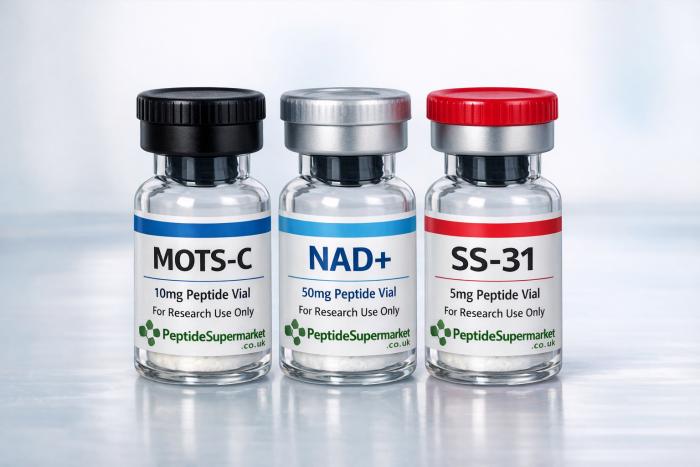
MOTS-C = programming engineer
NAD+ = fuel / electron-handling capacity
SS-31 = structural engineer (membrane protection)
This isn’t “supplementation.”
It’s bio-engineering your biology.
MOTS-C: The Programming Engineer
MOTS-C is a mitochondrial-derived peptide (encoded in mitochondrial DNA) that functions like a stress-response messenger.
Its job is to push metabolism away from dysfunctional, inflammatory energy patterns and toward more efficient energy handling.
At a practical level in this framework:
it helps correct metabolic signaling
it supports insulin sensitivity pathways
it acts like a software update for cells under metabolic stress
Programming matters because you can’t build durable energy production on corrupted instructions.
NAD+: The Fuel and the Quality-Control Driver
NAD+ is essential for:
electron movement in energy production
keeping oxidative phosphorylation functioning
supporting cellular repair systems (including sirtuin-linked maintenance)
As people age—and as inflammation rises—NAD+ tends to decline, which worsens mitochondrial performance, which worsens resilience.
That’s why the “fuel problem” isn’t just about calories.
It’s about whether the mitochondria can actually run the machinery efficiently.
SS-31: The Structural Engineer
The inner mitochondrial membrane is where the electrical “magic” happens.
Damage that membrane, and you lose:
membrane potential
proton gradient integrity
efficient ATP synthesis
SS-31 is designed to target the inner mitochondrial membrane and reduce damage from reactive oxygen species at the source—helping protect the structure that energy production depends on.
If you don’t fix structure, you can’t reliably scale performance.
Quick link: UK MOTS-C price comparison (compare listings and pricing in one place):
The Hierarchy of Mitochondrial Repair
This matters:
You don’t throw everything at the problem in a chaotic pile and call it a protocol.
The sequence logic is:
Fix programming + fuel first
install the “software update”
restore energy throughput
Then reinforce the structure
protect the membrane under the new, higher energy demands
Because you don’t rebuild a factory’s foundation while it’s running broken machinery at full throttle.
Addressing Common “Diseases” as Mitochondrial Failure
A lot of what modern medicine labels as separate diseases can be reframed as:
tissue-specific manifestations of mitochondrial energy collapse.
chronic fatigue syndromes → systemic ATP shortage
type 2 diabetes → mitochondrial dysfunction + insulin resistance loop
neurodegeneration → energy failure in high-demand brain tissue
cardiovascular disease → mitochondrial dysfunction in high-demand cardiac and endothelial tissue
aging → cumulative mitochondrial decline across tissues
This is why “treating the number” so often fails long-term.
You can’t spreadsheet your way out of a power plant failure.
The Power of Mitochondrial Health
If you fix mitochondria, you don’t just “feel a bit better.”
You change the upstream constraints that determine:
how you recover
how you think
how you train
how you resist disease
how you age
And here’s the clean finish:
Fix mitochondria = fix ATP capacity.
Fix ATP capacity requires fixing the three failures:
systemic inflammation
insulin resistance
ATP shortage (as the downstream result)
That’s the map.
Not hype.
Not dogma.
Not a meme.
Just physiology.
Compare Mots-C prices across the UK
Side-by-side prices from every trusted UK supplier stocking Mots-C.


