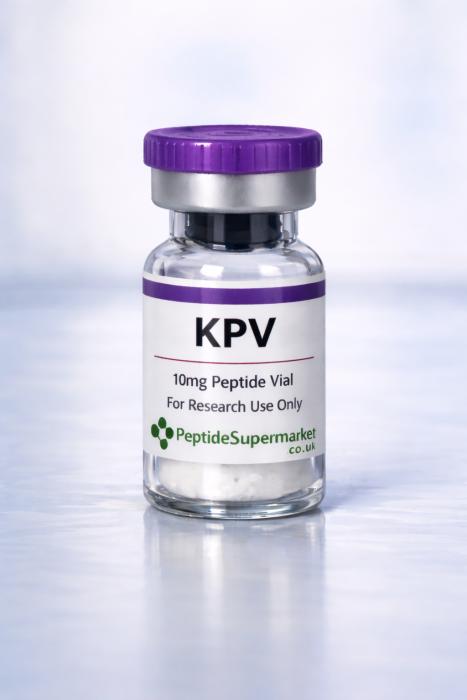
Introduction to KPV
KPV is the smart bomb.
It’s a tripeptide—three amino acids in a precise sequence:
Lysine
Proline
Valine
It’s not some synthetic alien molecule. It’s a fragment—a surgical piece—of a naturally occurring hormone in your body called alpha-MSH (alpha melanocyte-stimulating hormone).
Alpha-MSH has broad jobs: inflammation control, pigmentation, and energy homeostasis.
KPV is the C-terminal sequence of alpha-MSH—and that tiny fragment holds the core anti-inflammatory activity of the parent molecule.
Think of alpha-MSH as the entire command structure.
KPV is the special operations unit.
The target: IL-1β
KPV isn’t vague. It’s not “anti-inflammatory” in a fluffy way.
Its highest-value target is Interleukin-1 beta (IL-1β)—a cytokine that sits near the top of the inflammatory cascade.
When IL-1β is driving the bus, you see the classic damage pattern:
fever signaling
pain amplification
vasodilation
tissue destruction
Most common anti-inflammatories work downstream.
They show up late, after the building is already flooded, trying to mop up the mess.
KPV doesn’t mop.
KPV goes after the source.
KPV’s mechanism: shutting down the factory
KPV’s primary action is inhibition of the NLRP3 inflammasome.
The NLRP3 inflammasome is a multi-protein machine inside innate immune cells (macrophages are a key example). When that machine is active, it drives production and release of inflammatory signals—especially IL-1β.
KPV disrupts that machine so IL-1β production gets shut down at the source:
no functional inflammasome machine
no IL-1β assembly line
no IL-1β flood
That’s the difference.
For a UK-only KPV price comparison (so you can quickly compare listings), use our hub:
The delivery advantage: search-and-destroy where inflammation lives
KPV isn’t just about what it does.
It’s also about where it does it.
Inflamed and damaged tissue changes its behavior:
increased vascular permeability
altered transporter expression
active biochemical distress signaling
KPV is drawn to those areas.
That’s the idea of site specificity: inflamed tissue effectively “pulls” it in, while healthy tissue largely ignores it.
So a subcutaneous injection becomes a system-wide patrol with effects concentrated where the tissue is inflamed—without turning the rest of the body into collateral damage.
That’s positioned as the polar opposite of a broad systemic blunt instrument.
Where this shows up clinically
1) Inflammatory bowel disease: Crohn’s / ulcerative colitis patterns
In IBD, the intestinal mucosa becomes a war zone:
epithelial barrier compromise
immune cells stuck in constant activation
cytokine storm pattern that includes TNF-alpha, IL-6, and IL-1β
KPV is positioned as directly protecting the gut wall by shutting down the NLRP3 → IL-1β axis at the site of inflammation.
Not “manage symptoms.”
Preserve the structure.
2) Rheumatoid arthritis
RA is framed here as an autoimmune attack on synovial joints:
synovium becomes inflamed and proliferative
it invades cartilage and bone
IL-1β is treated as a master regulator of the process
A key downstream damage mechanism is the stimulation of synovial cells to produce matrix metalloproteinases (MMPs)—enzymes that chew up cartilage.
KPV is positioned as reducing severity and protecting joint structure by neutralizing the upstream inflammatory driver rather than chasing the downstream wreckage.
3) Psoriasis
Psoriasis is framed as systemic immune dysregulation with skin manifestations—an “inside-out” problem.
KPV is positioned as calming immune signaling so scaling, erythema, and plaque thickness reduce because the immune system stops driving the skin into pathological overproduction.
4) Fibromyalgia / chronic fatigue patterns (central sensitivity model)
This is framed as a CNS “wind-up” pattern:
glial cells become chronically hyperactivated
neuroinflammation increases pain amplification
lower pain threshold → allodynia and hyperalgesia
KPV is positioned as small enough to cross the blood-brain barrier and dampen glial activation and the neuroinflammatory cascade—addressing the amplification machinery rather than masking sensation downstream.
The unifying thread
Different diseases. Same root pattern.
Overactivation of the innate immune system—often centered on:
NLRP3 inflammasome activation
IL-1β overproduction
Handle the machine producing the signal, and the body can stop living in a permanent inflammatory emergency.
KPV is framed as a master key here because it doesn’t just block a downstream pathway—it tells the immune system, with precision, that the job is done.
Looking to compare KPV prices (UK)? Our price comparison hub puts the listings in one place:
Practical use pattern presented
KPV is presented as subcutaneous, site-targeted use.
A practical range that was stated:
100–500 micrograms
subcutaneously
at the site
1–2 times per day max
Final take
Chronic low-grade inflammation is positioned as the background noise accelerating every aging pathway.
KPV is framed as the clean, precise way to shut down the upstream ignition source—especially IL-1β—without carpet-bombing the body.
And when combined as a “repair stack” conceptually:
BPC-157
TB-500
GHK-Cu
KPV
(and for soft tissue injury: PEG-MGF)
…that’s presented as the closest thing to a full regeneration blueprint.
Compare KPV prices across the UK
Side-by-side prices from every trusted UK supplier stocking KPV.


