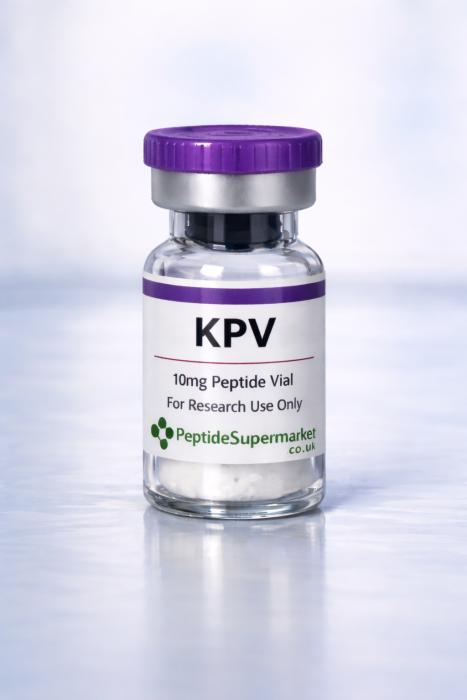
What KPV actually is
KPV is a tripeptide:
Lysine – Proline – Valine.
That’s it. Three amino acids.
And that’s the first thing people get wrong: they hear “three amino acids” and assume “small = minor.”
No.
Small means fast, targeted, and built for signaling.
KPV isn’t a poison. It isn’t random. It’s not a “foreign drug” your body has to tolerate.
It’s part of your internal control system—your body’s way of saying:
“Inflammation served its purpose. Now shut it down and start repairing.”
Where KPV comes from
KPV is produced by your body as a breakdown product of α-MSH (alpha-melanocyte stimulating hormone)—a peptide involved in immune modulation and inflammation control.
Your system can generate this signal in places that matter:
immune cells (especially at inflamed tissue sites)
gut
skin
other tissues involved in immune signaling
The headline: your body manufactures its own resolution signals on demand.
That’s not motivational poster stuff. That’s physiology.
Why “inflammation” is the most misunderstood concept in modern health
Most people think inflammation is:
redness
swelling
pain
heat
That’s not inflammation.
That’s what inflammation looks like from the outside.
Looking to compare KPV prices (UK)? Our price comparison hub puts the listings in one place:
Inflammation is a molecular war—a coordinated immune program that turns on gene transcription, recruits immune cells, floods tissue with signaling molecules, and changes metabolism.
A simplified version:
Damage or pathogen triggers immune “danger sensors”
That activates inflammatory control systems (one major hub is NF-κB)
Cells produce cytokines (think TNF-α, IL-6, IL-1β)
Blood vessels dilate and get leakier (redness + swelling)
Immune cells swarm in (heat + pain)
That’s the acute version—the correct version.
Then it should end.
The real problem is not inflammation — it’s unresolved inflammation
Chronic low-grade inflammation is like a smoke alarm that never shuts off. Even if you stop noticing it, the damage continues.
And that’s where everything spirals:
inflammation drives insulin resistance
insulin resistance feeds inflammation
both damage mitochondria
damaged mitochondria generate more oxidative stress
oxidative stress triggers more inflammation
That loop is the disease engine.
The key distinction: suppressing inflammation vs resolving it
This is where KPV is different.
NSAIDs (like ibuprofen) mostly suppress
They reduce prostaglandin production and can lower pain and swelling.
Useful sometimes—yes.
But suppression is not the same as resolution.
You can quiet the alarm without clearing the debris.
Steroids (like prednisone) can nuke inflammation
Steroids can be lifesaving in specific situations, but they come with well-known tradeoffs when used chronically (metabolic effects, immune suppression, bone effects, etc.).
Again: sometimes necessary, but not the same as restoring a stable, healed baseline.
KPV is framed as a “resolution signal”
In the way it’s commonly discussed in peptide circles: KPV doesn’t just try to “turn down” inflammation. It’s positioned as something that helps the immune system pivot from attack mode to cleanup-and-repair mode.
That’s the whole point.
What KPV is claimed to do mechanistically
Here’s the clean version of the “how,” without the detours:
1) It downshifts NF-κB activity
NF-κB is a central switch that turns on inflammatory gene expression.
When NF-κB stays active too long, cytokine production stays high and tissue stays in “war mode.”
KPV is often discussed as helping reduce NF-κB-driven signaling, which means less chronic cytokine amplification.
2) It supports pro-resolution signaling
A major theme in the transcript is that KPV doesn’t just reduce pro-inflammatory output—it also nudges the system toward resolution signals (commonly discussed via anti-inflammatory cytokines like IL-10).
3) It shifts macrophages toward cleanup mode
Macrophages are immune “multi-tools.”
one mode is aggressive, inflammatory, threat-focused
another mode is repair-oriented, debris-clearing, rebuilding-focused
KPV is often described as encouraging that shift toward the repair/cleanup phenotype, which is what you want once the acute threat is handled.
That’s the difference between:
“Stop the fight”
and“End the fight and rebuild the city.”
Why people care about KPV: where it shows up conceptually
This is the part that makes people perk up, because unresolved inflammation isn’t “one problem.” It’s the common denominator.
Gut and barrier integrity
Chronic inflammation + barrier breakdown = immune chaos.
When the gut barrier becomes leaky, immune activation doesn’t stay local—systemic inflammation rises and downstream effects snowball.
In peptide conversations, KPV is often positioned as useful because it’s tied to immune modulation in gut-related inflammatory states.
Skin (eczema, dermatitis, psoriasis-style inflammation)
Skin conditions often reflect immune signaling problems, not “surface-level issues.”
The transcript frames KPV as potentially helpful because it targets inflammatory signaling and supports barrier normalization.
Brain (neuroinflammation)
The brain is metabolically expensive and extremely sensitive to inflammatory spillover.
A recurring hypothesis in neurodegenerative discussion is that chronic immune activation + barrier disruption + mitochondrial stress create a long runway toward decline.
The transcript frames KPV as relevant because it’s discussed as:
inflammation-modulating
resolution-supporting
protective of cellular energy systems indirectly (by reducing inflammatory stress)
Cardiovascular system (endothelial inflammation)
Atherosclerosis is increasingly understood as an inflammatory process at the vessel wall.
The “KPV angle” in the transcript is: if you reduce endothelial inflammatory activation, you reduce the conditions that drive progression.
Kidneys (inflammation → fibrosis)
Kidney decline often involves inflammatory signaling and fibrotic remodeling.
The transcript frames KPV as potentially protective by reducing inflammatory signaling that pushes fibrosis.
If you’re researching KPV and want to compare peptide prices in the UK, start here:
The part people miss: “resolution” is a longevity concept
If you want the big takeaway that ties the whole monologue together, it’s this:
Longevity isn’t about never inflaming.
It’s about inflaming appropriately—then resolving completely.
Inflammation is necessary.
Unresolved inflammation is aging fuel.
So the “pitch” for KPV in this worldview is that it’s not just a pain-reducer. It’s a resolution tool—a way to help the body finish the inflammatory program properly instead of getting stuck in chronic activation.
Reality check that keeps this responsible
KPV gets talked about like a miracle molecule. A more grounded framing is:
It’s a biologically plausible immune-modulating tripeptide derived from α-MSH pathways.
A lot of the strongest “wow” mechanistic claims people repeat online come from preclinical research and extrapolation.
It is not an FDA-approved medication for chronic disease reversal, and it’s not a substitute for medical care.
That doesn’t mean “worthless.”
It means: treat it like a serious signaling tool, not internet candy.
The clean conclusion
KPV is presented as one of the most important “small” peptides because it sits at the hinge point most people never address:
the transition from inflammation to resolution.
Not symptom muting. Not “take something to feel less.”
Resolution.
And if you understand that difference, you suddenly understand why so many people are stuck in chronic decline despite endless supplements, prescriptions, and protocols:
They’re turning down alarms.
They’re not clearing the fire.
Compare KPV prices across the UK
Side-by-side prices from every trusted UK supplier stocking KPV.


